This study analyzed the relationship between subjective happiness (positive affect) and objective biosignals (heart rate variability) in depth, tracking approximately 300 participants over 24 hours. The findings show that self-perceived positive emotions and biological stress responses are closely linked, and that activities like exercise and eating lower stress and increase happiness. The study also revealed that the time of day, the duration of activities, and the sequence of activities all significantly influence our mood and physiological stress levels.
1. Introduction: The Limitations of Surveys and New Opportunities
The most common method in research exploring human nature, particularly the measurement of emotions, is the survey. But there is one major problem: people's subjective self-reports are highly susceptible to bias due to social pressure and memory errors. Scientists have therefore continuously questioned how reliable survey responses about subjective happiness really are.
Good science relies on unbiased knowledge from which conclusions can be drawn, but subjective self-reports are vulnerable to numerous confounding factors -- particularly the social desirability effect (the tendency to appear favorable to others).
However, technological advances have opened new opportunities: wearable sensors. These devices, which are minimally intrusive to wear, can record behavior and biosignals in real time as people go about their daily lives. Some scholars have even called this technology "social fMRI."
The core goal of this study is to determine whether the objective biodata obtained through these "Reality Mining" tools actually correlates with the subjective happiness people report in surveys. If the two align well, we gain a powerful tool to complement the limitations of surveys and understand human happiness more accurately.
2. Methods: Recording the Mind and the Heart
To achieve this goal, the researchers collected two key types of data.
Activity Logs and Mood Assessments
Participants recorded what they were doing over a 24-hour period (e.g., conversing, eating, commuting, sleeping) and their mood at each moment. Mood was rated by selecting either positive or negative emotions and indicating their intensity. The research team combined the two lowest categories to create a metric called Positive Affect. Recording emotions in real time reduces the "recall bias" that occurs when trying to remember and log feelings after the fact.
Heart Rate Variability (HRV) Measurement
Participants wore a heart rate monitor on their chest as they went about their daily lives. This device records electrocardiogram (ECG) data, enabling analysis of autonomic nervous system activity. The most important metric here is the LF/HF ratio.
- Sympathetic nervous system (SNS): Activated during fight-or-flight responses, increasing heart rate (LF band).
- Parasympathetic nervous system (PNS): Activated during rest and relaxation, decreasing heart rate (HF band).
The LF/HF ratio reflects the balance between these two systems: a higher value indicates greater mental stress or tension. The researchers used this objective metric to measure participants' physiological stress levels.
3. Study Sample: 24 Hours in Austria
Data collection was conducted between 2006 and 2008 among residents of Austria, primarily in the Vienna area. A total of 344 people participated, but the data went through rigorous sanity checks to ensure accuracy.
Cases with excessive noise in heart rate data, incorrect age records (under 18 or over 80), or insufficiently recorded activity durations were excluded. Sleep periods and activities shorter than 5 minutes were also excluded from HRV analysis.
Ultimately, the final analysis used mood assessment data and heart rate data from 321 participants (5,575 activities) out of a pool of 1,152 participants. The average age was 43.2 years, with a balanced gender ratio.
4. Finding 1: The Correlation Between Stress and Happiness
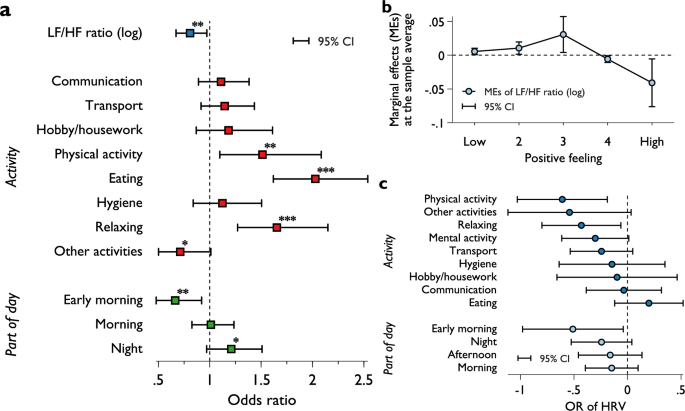
The analysis revealed a highly interesting and important finding: there was a clear negative correlation between objective physiological stress (LF/HF ratio) and subjective happiness (positive affect). In other words, when the heart was sending stress signals, people actually reported feeling less happy.
A 10% increase in the LF/HF ratio reduces the odds of reporting more positive affect by 1.92%.
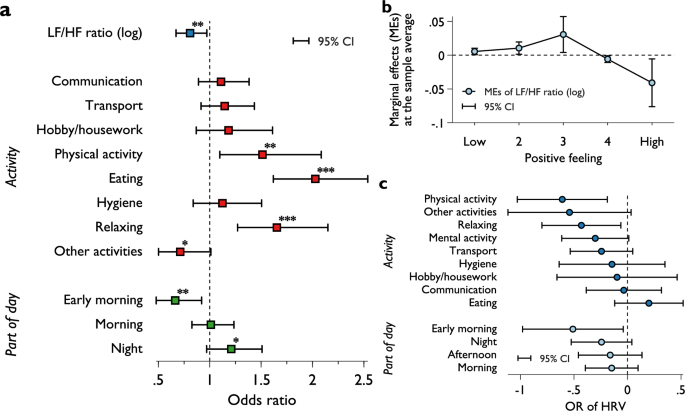
Figure 1 above shows that as the LF/HF ratio rises (higher stress), the probability of feeling positive emotions decreases (panels A, B). By activity type, physical activity, eating, and relaxing were associated with much higher probabilities of positive emotions compared to mental activities (such as work). Conversely, work-related mental activity was associated with relatively lower happiness.
5. Finding 2: The Power of Time and Duration
Happiness and stress also varied depending on the time of day and how long an activity lasted.
Changes Throughout the Day
People felt more positive moods later in the afternoon and evening (5 PM to midnight). Meanwhile, physiological stress (LF/HF ratio) peaked in the afternoon before settling back down in the evening.
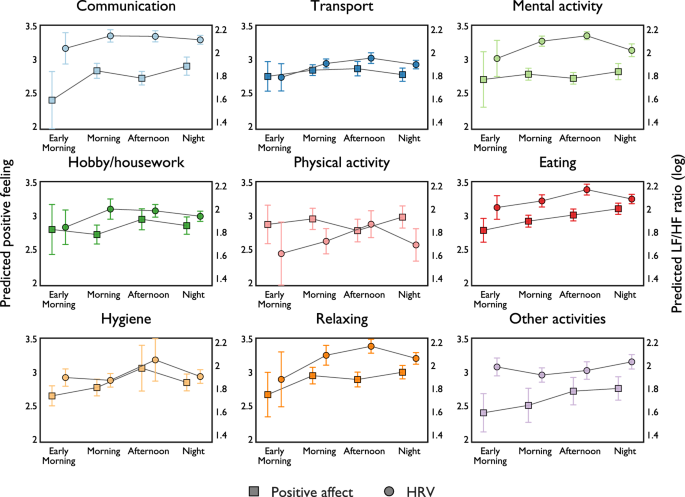
Figure 2 shows changes over time by activity type. Eating, hobbies, and relaxation showed a clear upward trend in positive affect (square data points) as the day progressed.
The Effect of Activity Duration
"How long you do something" mattered too. Figure 3 reveals an interesting contrast.
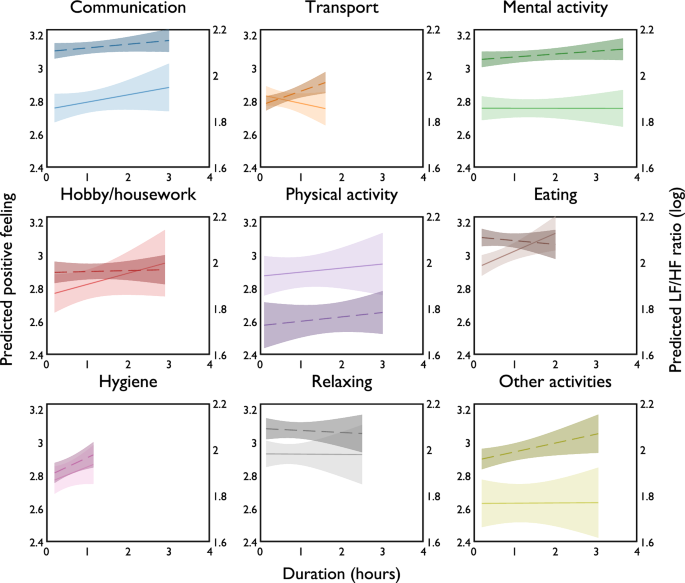
- Time that makes you happier: Eating, hygiene activities (bathing, etc.), conversation, and hobbies all showed higher positive mood the longer they lasted.
- Time that stresses you out: In contrast, transport time reduced positive mood and sharply increased physiological stress (dashed line) the longer it lasted. This aligns with existing research showing that long commute times decrease life satisfaction.
6. Finding 3: What You Did First Matters
Another distinctive aspect of this study is its analysis of the sequence of activities. Does what I did just before, or what I plan to do next, affect how I feel right now?
The study confirmed a spillover effect from previous activities.
- Activities performed immediately after exercise, eating, or relaxation were associated with higher-than-usual positive emotions. In particular, mood was approximately 1.6 times better after exercise.
- In contrast, commuting or housework had no notable positive spillover effect.
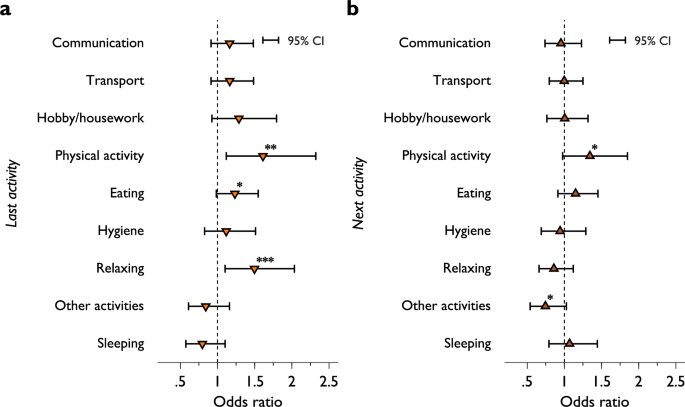
Prospection -- anticipation of the future -- also played a role. When exercise was scheduled as the next activity, current positive affect was higher.
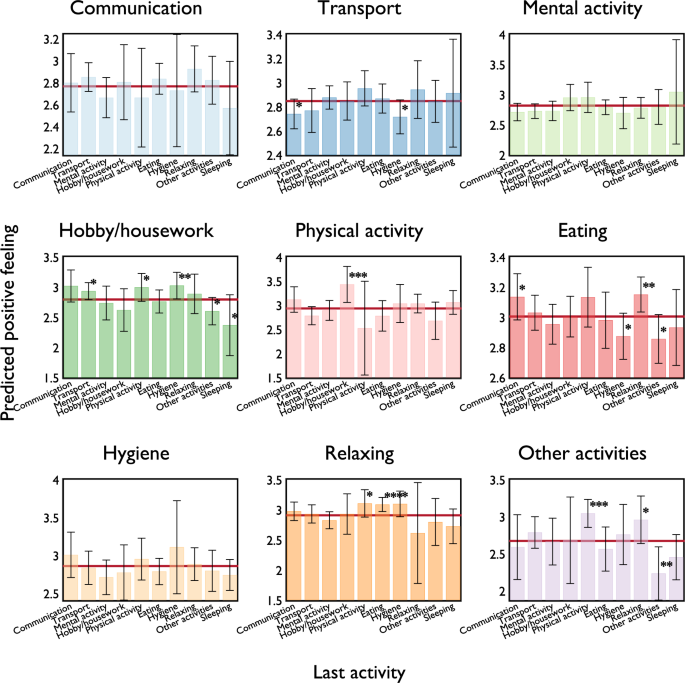
Figure 5 shows specific activity combinations. For instance, resting after exercise, or eating after bathing (hygiene) tended to increase happiness.
The exploring mind must perform the "seeing" and "feeling" of simulating what the future might be like, thereby placing future possibilities on the same plane as what is actually seen and felt in the present.
7. Conclusion: Toward Better Happiness Measurement
This study delivers two important messages.
First, our feelings are not wrong. The happiness people self-reported through surveys aligned very well with objective heart rate data. This suggests that subjective survey data, widely used in social science, can be a reliable policy tool.
Second, daily activity patterns matter. Exercising, eating good food, and resting sufficiently do not just improve mood -- they actually lower physiological stress levels. Conversely, long commutes and excessive work burden both body and mind. Moreover, simply arranging activities in the right order (e.g., resting after exercise) can increase happiness.
Finally, the researchers emphasize that the widespread adoption of wearable devices like Apple Watch and Fitbit represents a major opportunity for future research.
When data from affordable devices is used together with the data preparation and analysis methods presented in this paper, it becomes possible to map the thought processes related to individual well-being and stress levels in greater detail and dynamism.
We now live in an era where anyone can track and understand their own stress and happiness patterns without expensive medical equipment. When did your heart beat most peacefully today?