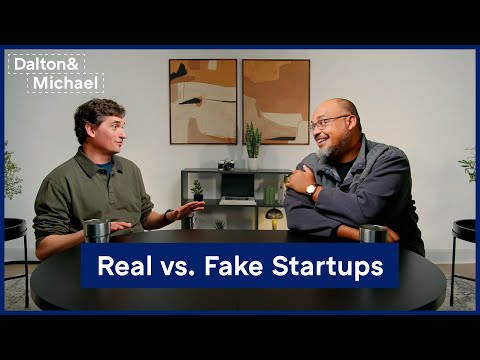
What is the difference between a "real" startup and a "fake" startup? In this video, Dalton and Michael explain the critical difference between simply playing at being a startup and actually building products for customers. It covers the common trap of "fake" startup behavior that founders fall into, misconceptions about successful tech companies, and insights on how to course-correct even now.
1. Seeing "Fake" and "Real" Through Extreme Examples
Dalton and Michael begin by comparing two highly extreme and satirical archetypes to clarify the concepts.
First is the extreme example of a "Fake Startup." These companies never build a product. They do not write a single line of code. Instead, they hire a ton of people, and the founders are somehow obsessed with getting their names on lists like "30 Under 30."
It's almost like performance art. Like a modern artist trying to edgily deconstruct startup culture. That's what a fake startup is. Like the difference between being on stage in the musical Hamilton and actually being there in real life -- everything is a performance.
On the other end, what does the extreme caricature of a "Real Startup" look like? They work around the clock (like a 996 schedule). The company has zero non-technical staff -- only programmers. They do not even use existing programming languages; they build their own for scalability. Sales? They believe they do not need it.
In our era, Google was the textbook example of what "real" looked like for early founders. Just hardcore. Like wanting to hire based on SAT scores. As founders, we were taught that was the gold standard of a hardcore organization.
But it is important to remember that both of these are exaggerations of reality.
2. Misconceptions and Truths About Successful Companies
People commonly misunderstand companies like Google and Stripe that they consider exemplars of "real startups." The reality is that they did not succeed purely on technical prowess.
Google is actually one of the world's greatest advertising sales companies, and Stripe -- which appears to be a developer-centric tool -- is one of the world's top enterprise software payment companies. In other words, truly successful companies are phenomenally good not just at technology development but also at sales and marketing.
Yet many founders create false myths about the companies they admire and doom themselves by trying to follow those myths.
"Google didn't do marketing," or "That company grew 100% through self-service without any sales"... If you create myths about successful companies that aren't true and use those as your North Star, you're really setting yourself up for failure.
3. Why Do Founders Fall Into the "Fake" Trap? (Feat. Cargo Cult)
So why do perfectly reasonable people end up playing "fake startup"? Michael explains this through the phenomenon of "Cargo Culting."
- Social mimicry: Humans are social animals and imitate those around them. People who learn about startup culture only through Twitter (X) think that renting an office, hiring staff, and booking investor meetings is what a startup is. They mimic the appearance while forgetting the substance (the product).
You rent an office, hire people and put them in the office, and do investor meetings. That's a startup, right? Put these three together and Google pops out, right? (...) Google didn't succeed because they had pastel-colored balls in the office or served lunch. The most important thing -- the high order bit -- was that they built a really good search engine.
- Bad starting conditions and impatience: When conditions are unfavorable (no technical co-founder, cannot leave your day job, etc.) and you feel urgency, it is easy to slip into "fake" mode. Instead of putting effort into making barren soil fertile, you convince yourself that sheer "grit" will somehow overcome any adversity.
The ground is full of rocks and nothing grows, but instead of asking "How do I make this soil fertile?" you hypnotize yourself into believing that grit alone can overcome any bad condition. (...) I tell founders: use that grit to improve your starting conditions. That's far more efficient.
4. Why YC Pushes Technical Founders to Do Sales
Y Combinator (YC) tends to select technically-oriented teams that build "real" products. But ironically, the advice YC partners give them most often is "do sales and marketing."
Why? Because good advice gets you to do things you would never have done on your own. Telling people who are already good at coding to code more does not help.
I encourage many founders building technical tools and developer tools to please take the time to post about their product and let the world know it exists. If nobody knows your technology exists, that's game over. Whether you admit it or not, the best technologies do great marketing.
Many developer-turned-founders think "if the product is good, it'll sell itself" and try to stay locked in their ivory tower. But even recent success stories like PostHog do an enormous amount of developer marketing.
In Closing
The most important thing is to honestly ask yourself whether you are working toward "taking a real shot" or merely playing at being a startup.
If you feel that you are currently in the "fake" territory of focusing on appearances, do not worry. As Michael says, it is never too late to fix things.
If you realize you're in the "fake" camp, take action. (...) Use your grit to improve your starting conditions. That's a much higher-leverage activity.