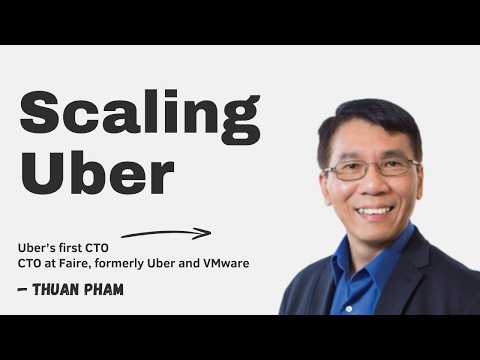
This video is an in-depth conversation with Thuan Pham, Uber's first CTO, covering his remarkable career and how he led the company through explosive growth. He shares his journey from childhood as a boat person fleeing the aftermath of the Vietnam War, through MIT, VMware, and ultimately his tenure as Uber's CTO. The conversation offers deep insight into how Uber overcame a wide range of technical and organizational challenges — unstable systems, the microservices migration, entering the Chinese market, and scaling the engineering organization. His current perspective as CTO of Faire on AI's impact on software engineering and the evolving role of the CTO is also on full display.
1. From Vietnam to America: A Difficult Childhood and a First Encounter with Technology 🚀
Thuan Pham recounts the hardships of growing up in the middle of the Vietnam War. When South Vietnam fell in 1975 and the North unified the country, his family — connected to the southern regime — faced enormous adversity. Thanks to his mother's courageous decision, he became one of the "boat people," surviving a dangerous journey with less than a 50% survival rate before settling in the United States.
"I was born in Vietnam, a child of the Vietnam War. When South Vietnam fell in 1975 and North Vietnam won, anyone associated with the southern government had almost no opportunity to grow — no access to education, none of that. My mother didn't want her two sons growing up without opportunity, so she made a very bold decision. We had to leave our homeland."
He arrived in America with nothing and no knowledge of English, but with the help of a church sponsor and his own drive, he pursued his education. In high school, a friend's IBM PC sparked his interest in computers, and his natural algorithmic thinking and aversion to repetitive work revealed a genuine talent for coding.
"I'm generally a procrastinator. I hate doing the same thing twice. So computer programming was perfect for me. Solving a problem once — that's the creative part — and after that I got bored and moved on to the next problem."
He went on to write code as a volunteer for a government agency, automating accounting tasks, and later built a strong foundation in computer science at MIT.
2. Growing Up in Silicon Valley: HP, Silicon Graphics, and the Dot-Com Bubble 🎢
After graduating from MIT, Thuan Pham began a promising career at HP Labs, working on cutting-edge research in medical informatics. But frustrated that the research rarely translated into actual products, he sought out a role where he could write code users would directly touch, and moved to Silicon Graphics (SGI).
At SGI, he developed future technologies — video streaming, video-on-demand, online gaming — through an interactive TV project, but he learned a hard lesson: the technology was too far ahead of its time.
"The problem was that we were too far ahead of the curve. That's when I learned a big lesson: it's not just about the technology — it's about whether the world is ready for it, and whether it makes economic sense."
He then joined a startup called NetGravity, building an online advertising platform and experiencing the early growth of the internet era. During this period he gained a critical insight about balancing growth and profitability. While competitors chased growth, NetGravity pursued profitability — and watching a rival (later acquired by Google) dominate the market taught him the importance of market share.
The dot-com bust frightened many, but Thuan Pham held firm to the belief that "talent is always talent."
"The dot-com bubble was a bit scary during the correction. But before that, everything was dot-com. … In the end, you need a healthy business model that generates sustainable revenue. Growth alone just burns money, and that's not good. You can grow fast, but eventually you have to turn profitable to become a sustainable company."
"Talent is always talent. People with truly strong skills who are always pushing beyond their own capabilities will always be marketable."
3. VMware: At the Forefront of Virtualization 📈
After the dot-com bust, Thuan Pham joined VMware when it was a 40-person company. He immediately recognized that VMware's virtualization technology was a game changer that would reshape the industry. In particular, he saw that vMotion — the ability to move virtual machines between hardware with zero downtime — would form the foundation of cloud computing.
He contributed to building VMware's enterprise cloud platform, growing alongside the company and rising to VP of Engineering. But rather than settling into comfort, he kept looking for new challenges.
"It wasn't as extreme as Uber, but it was definitely a game changer — technology that would transform an entire industry. … The core feature, vMotion, is what made the entire cloud possible. Thousands of machines could appear as one. The application inside your machine could scale, move on its own, and do everything it needed to do."
"I have this strange quirk: when things get big and I start getting too comfortable, I get anxious."
4. Joining Uber: Laying the Foundation for Scale in the Midst of Chaos 🤯
In 2013, Thuan Pham joined Uber as its first CTO. At the time, Uber had 40 engineers and handled 30,000 trips a day — but the systems were going down multiple times a week. A 30-hour deep-dive interview with CEO Travis Kalanick left him genuinely excited about Uber's technical vision and challenges.
"It was pretty small back then. When I pulled the data, there were about 30,000 trips a day. … The engineering team was very young but quite tenacious, dedicated, and talented. … The system wasn't built for scale. It was built for functionality. … And it went down multiple times a week."
His first priority after joining was identifying the vulnerability in the dispatch system and ordering a complete rewrite in just five months to prevent systemic collapse. He gave the engineers only two core requirements: "a city runs on multiple servers, and a server runs multiple cities" — keeping the scope tight to drive fast execution.
"The dispatch system was first. Without dispatch, there's nothing. … I looked at the first system, reviewed the architecture and implementation plan. … One requirement was that a city must run on multiple boxes. The other was that a box must run multiple cities. That was it. So that we could have an N × M structure."
This adaptive, incremental rewrite approach allowed Uber to keep its systems intact through breakneck growth.
5. Entering the Chinese Market: Making the Impossible Real 🇨🇳
In 2014, Travis Kalanick gave Thuan Pham what seemed like an impossible directive: launch Uber in China within two months. The prevailing estimate was that rebuilding the existing systems for China's environment would take at least 18 months.
"It was one of the craziest things we ever did, but also one of the most amazing. … At the time there was a requirement that all services had to run on servers inside mainland China. … He said two months, and I said, 'That's really hard.' He said, 'Why? You just set up servers and copy the software — there's no reason it should take more than two months.'"
But Thuan Pham and his team embraced the challenge, driven by a "can-do" mindset and Uber's culture of moving fast. They launched in China in five months. The strategic decision to start with Chengdu — the hardest city — was instrumental in building the team's confidence.
"I think tackling the hardest thing first is the best approach. Once you pull that off, everything else is a piece of cake. The team gains confidence, and they can push through the next cities with conviction."
"Nobody thought we could pull all of this off, but we just put our heads down and solved it one piece at a time."
6. Splitting into Platform and Program, and the Microservices Architecture 🏗️
As Uber's engineering organization grew rapidly, a functional org structure created bottlenecks. To address this, Thuan Pham introduced an innovative split: "Platform" and "Program."
- Program teams: Teams building the products end users interact with directly (e.g., the Uber app).
- Platform teams: Teams building the tools and foundational layers that other program teams rely on.
"With a functional org structure, we stopped being able to grow. … Every feature had to queue up behind the bandwidth of the mobile team or the dispatch team, and negotiating trade-offs became impossible."
"Platform builds the tools and layers; program teams build what end users use. That's the concept of horizontal versus vertical."
This restructuring let teams move independently and quickly, and it laid the groundwork for the eventual migration from a monolithic architecture to thousands of microservices. Early on, the challenge was that business growth was so fast that new features kept being added to the monolith even as the team worked to extract code from it — but in the end, the migration was the only way to keep up with Uber's explosive growth.
"We immediately knew the monolithic backend API would slow us down. So we declared: everything new must be built outside the monolith."
"We had no choice but to split into thousands of microservices to handle all of these problems at once."
7. Uber's Homegrown Tools and the Helix App Rewrite 🛠️
Uber's rapid growth exposed technical limits that existing open-source solutions couldn't handle. PostgreSQL, for example, started throwing random errors beyond a certain scale, and there was no clear path to a fix.
"When we started at Uber, we used almost entirely open-source tools. … But as we scaled, we kept hitting the limits of those open-source tools' capabilities, and eventually we ran into walls."
"One of the early cases that was particularly painful was that we were using PostgreSQL. … At a certain scale, PostgreSQL would throw random errors, which randomly brought down our services."
To solve these problems, Uber built a large number of homegrown tools — Schemaless (data store), Jaeger (tracing), M3 (monitoring), and others — several of which were open-sourced and went on to have significant industry-wide impact.
Uber also completely rewrote its mobile app under the codename "Helix" to improve user experience and enable future extensibility. It was a massive project consuming enormous resources, but it was brought to completion under the firm vision of Travis Kalanick and designer Yuki, and the architecture built then remains the foundation of the Uber app to this day.
"Travis had a vision: the current app is too limited. … The new architecture was far more open. … 700–800 engineers worked on it for 7–8 months, and it's still in use today."
8. Organizational Culture and Leadership: "This Is Not a Mickey Mouse Shop!" 😠
As CTO, Thuan Pham paid close attention to the culture and growth of the engineering organization. He stressed the importance of clear, consistent naming conventions so that new engineers could get up to speed quickly, and he wasn't shy about delivering that message forcefully. When services were being given cryptic names like "Mustafa," he sent a pointed all-hands email: "This is not a Mickey Mouse shop." 🐭
"I understand that young engineers want to have fun. … I have no idea what this means. … I made it very clear: this is not a Mickey Mouse shop."
He also made it easy for engineers to transfer to other teams, which reduced attrition and motivated managers to invest in their people.
"I thought the best approach was to keep creating opportunities for engineers to keep growing with new challenges inside the company. … Managers need to be motivated to care for, develop, and grow their team members."
"This isn't a prison. Nobody can be held captive. Everyone has free will."
9. Thuan Pham's "Three Tours of Duty" and Leaving Uber 🫡
Thuan Pham defined his seven years at Uber as three distinct tours of duty.
- First tour: The first 18–24 months — stabilizing an unstable system and making it work.
- Second tour: Scaling globally (e.g., the China market launch).
- Third tour: Helping the company navigate crisis during the leadership vacuum and turbulent period of 2017.
He completed his third tour and left Uber in 2020. His departure was born of personal reflection — he had reached a stage in life where "money no longer mattered." He described making the decision through three questions: whether his work aligned with his mission, whether he was having a large impact, and whether he enjoyed the people he worked with.
"I had reached the purpose of my life. Money doesn't matter. … So I ask three questions. First: do I truly love what I'm doing and the mission? Second: do I feel like I'm really having a big impact by being there? Third: do I enjoy being with the people I work with?"
10. After Uber: Coupang, Nubank, and Faire 🌟
After leaving Uber, Thuan Pham briefly considered retirement — but COVID-19 derailed his travel plans and drew him back to look for new opportunities. He joined Coupang, the South Korean e-commerce giant, and was amazed by its logistics system: order before midnight and your package arrives by 5 a.m.
"I joined Coupang. … If you order before midnight, it's at your front door by 5 a.m. While I was there I joined the delivery trucks at 2 and 3 in the morning, dropping packages at people's doors. It was an incredible experience."
He also became a board member and CTO mentor at Nubank, Latin America's leading fintech, where he emphasized the importance of global talent and the joy of learning.
"Nubank's culture was incredibly vibrant. It reminded me of early Uber. Everyone was passionate, the founders were passionate. … The product vision was great, the culture was extraordinary."
He is currently CTO of Faire, a B2B wholesale marketplace, where he is focused on leveraging AI to improve retailer search and recommendations and boost engineering productivity. He introduced new AI-driven development practices like "swarm coding," reporting a doubling of engineering productivity in the early stages.
11. Software Engineering and the CTO's Role in the Age of AI 💡
Thuan Pham emphasizes that AI is rapidly reshaping the paradigm of software engineering. AI now enables people with no programming background to generate good code, "elevating the playing field."
"Tell me how AI is changing software engineering and what skills we'll value. It's already changing. This change is moving faster than anything I've seen since the internet."
"AI lets people who don't know how to program now produce good code. … AI is leveling the playing field."
Even in this environment, he believes great engineers will continue to differentiate themselves — by using AI tools to maximize productivity, push new boundaries, and bring curiosity, boldness, and a drive to innovate. He was emphatic: "Complacency is death." You must keep learning and growing.
As CTO, he named two things as his most critical responsibilities: "building a high-performance team" and "seeing into the future." Attracting top talent, fostering a collaborative culture, anticipating the business and technology landscape two years out, and securing the capabilities needed in advance — those are the core imperatives of a CTO, he explained.
12. Advice for Young Engineers 🎓
Thuan Pham acknowledged the uncertainty in today's job market while affirming that talented people will always find opportunities. His message to young engineers: "invest in yourself, and focus on learning by tackling difficult and challenging problems early."
"I have to acknowledge that for people entering the workforce right now, it's a scary time because it's so uncertain. … Great people are still finding opportunities."
"Invest in yourself while you're a student. Volunteer to solve hard problems early. The earlier and harder you work in the early days, the brighter your future will be."
He also broke career development into three stages:
- The first 5–10 years: Seek out the opportunity to learn the most and pour in the most energy.
- The middle stage: Find opportunities to leverage your knowledge and make a large impact.
- The later stage: Focus on teaching people, mentoring, and giving back what you've learned.
Closing 👋
The conversation with Thuan Pham offered invaluable insight into the technical leadership and problem-solving that defined his time as Uber's CTO, and into how individuals and organizations must grow amid a constantly changing technological landscape. His human-centered leadership and passion for continuous learning resonated deeply. In a rapidly changing era of AI, the core values that never go out of style — curiosity, boldness, and the will to innovate — will remain a lasting source of inspiration for every engineer.