
System 1 (fast and intuitive) and System 2 (slow and logical) thinking, introduced in Kahneman's Thinking, Fast and Slow, are cognitive models deeply involved in our everyday judgments and decision-making. These two systems cooperate and sometimes conflict, contributing to both the efficiency of our behavior and the errors and biases we experience. This article thoroughly explains the concepts, history, real-world examples, misconceptions, and practical applications of these two systems in chronological order.
1. What Are System 1 and System 2?
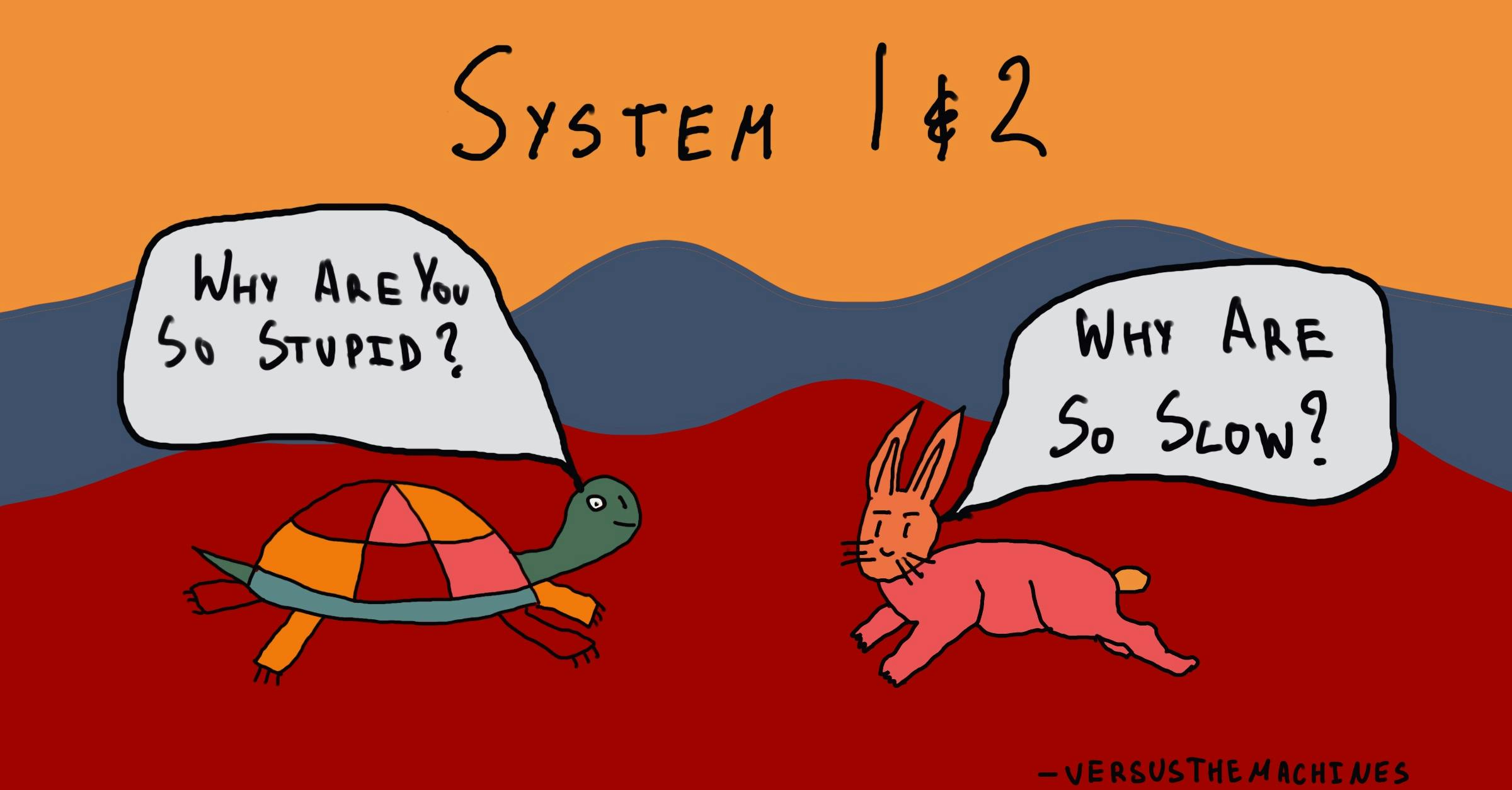
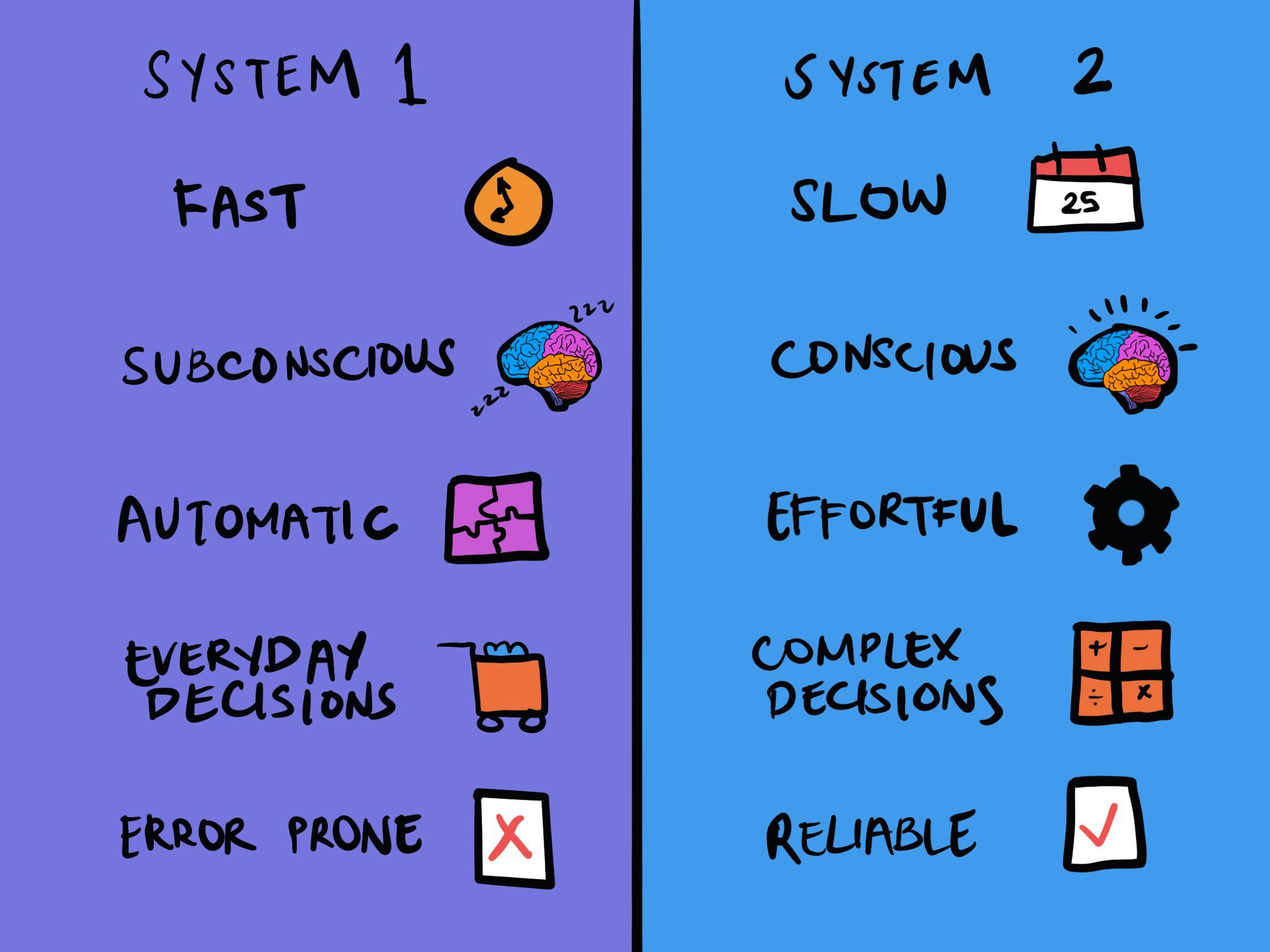
System 1 operates quickly, automatically, and intuitively. Because it requires little effort, we make many decisions without even being aware of it -- much like commuting along a familiar route.
In contrast, System 2 is slow, deliberate, and requires conscious effort. It engages when thinking through complex problem solutions or making analytical decisions in unfamiliar situations.
"The automatic operations of System 1 generate surprisingly complex patterns of ideas, but only the slower System 2 can construct thoughts in an orderly series of steps."
-- Daniel Kahneman, Thinking, Fast and Slow
For example, imagine your usual subway line suddenly stops running. You experience the moment of switching from automatically heading to the station (System 1) to deliberating and analyzing alternatives (System 2).
Understanding how these systems interact can help us recognize the biases driving our decisions and make better choices.
2. Key Terms and Differences Between the Systems
Key Terms
- System 1 Thinking: Fast, automatic, unconscious, and emotional responses. Examples: tying your shoelaces without thinking, skimming an advertisement.
- System 2 Thinking: Slow, effortful, logical, and analytical. Examples: finding a friend in a crowd, deciding on lunch when calculation is needed.
- Automatic Thinking: Nearly synonymous with System 1 -- instinctive, unconscious perception.
- Reasoning: The process of logically reaching conclusions using existing information, a hallmark function of System 2.
- Dual Process Model: The psychological theory that human thought is divided into conscious and unconscious processes.
- Behavioral Economics: The field studying how these cognitive processes influence economic decisions.
The image below illustrates the characteristics of System 1 and System 2 at a glance.
3. The Birth and Evolution of Systems 1 and 2 Theory
17th-19th Century: Philosophical Roots of Dual Thinking
From Descartes' mind-body dualism to William James, who in his late 19th-century work The Principles of Psychology distinguished between experience-based "associative knowledge" and "true reasoning" used in unfamiliar situations. This laid the groundwork for the modern System 1 and 2 theory.
20th Century: Formalizing the Dual Process Model
In 1975, Michael Posner and Charles Snyder distinguished between "automatic vs. controlled" thinking in Attention and Cognitive Control.
- Automatic processes: Occur without intention, consume few resources, cannot be voluntarily controlled, unconscious.
- Controlled processes: Intentionally initiated, consume many resources, can be voluntarily stopped, conscious.
As John Bargh pointed out in 1992, these four conditions have limitations in explaining the full complexity of actual human thought.
21st Century: Kahneman's Popular Dissemination
In the 2000s, Keith Stanovich and Richard West coined the terms "System 1 & 2," which Daniel Kahneman then popularized through his 2011 book Thinking, Fast and Slow. Kahneman opened new perspectives for analyzing human judgment and economic behavior by showing how cognitive biases arise from the interaction of these two systems.
"The experience of trying not to stare at the oddly dressed couple at the restaurant, the experience of forcing yourself back to the beginning of a dull book, or the experience of trying not to swear at someone -- in these moments, System 2 plays the role of self-control, overriding the impulses of System 1."
-- Daniel Kahneman
4. Key Figures
- Daniel Kahneman: A giant of behavioral economics who brought "System 1 and 2" to popular attention in 2011.
- William James: 19th-century American psychologist and philosopher, a pioneer of dual thinking frameworks.
- Michael Posner: Formalized the "automatic vs. controlled" thinking distinction.

5. Frequently Asked Questions (FAQ)
-
Q. Do System 1 and 2 operate simultaneously?
- Yes, in most situations the two systems cooperate simultaneously. For example, when cooking a new dish, basic cooking skills are handled by System 1, while new techniques like frosting piping are handled by System 2.
-
Q. Where do heuristics fit in?
- Heuristics are a classic example of automatic thinking and a characteristic of System 1. However, System 2 can also be susceptible to biases.
-
Q. Which system is better?
- It depends on the situation. System 1 is efficient for routine, repetitive tasks, while System 2 is more necessary for important decisions and complex problems.
-
Q. Is this related to habit formation?
- Yes! Habits are processes that start in System 2 and, through repetition, "transfer" to System 1.
6. Real-World Applications and Impact
Marketing
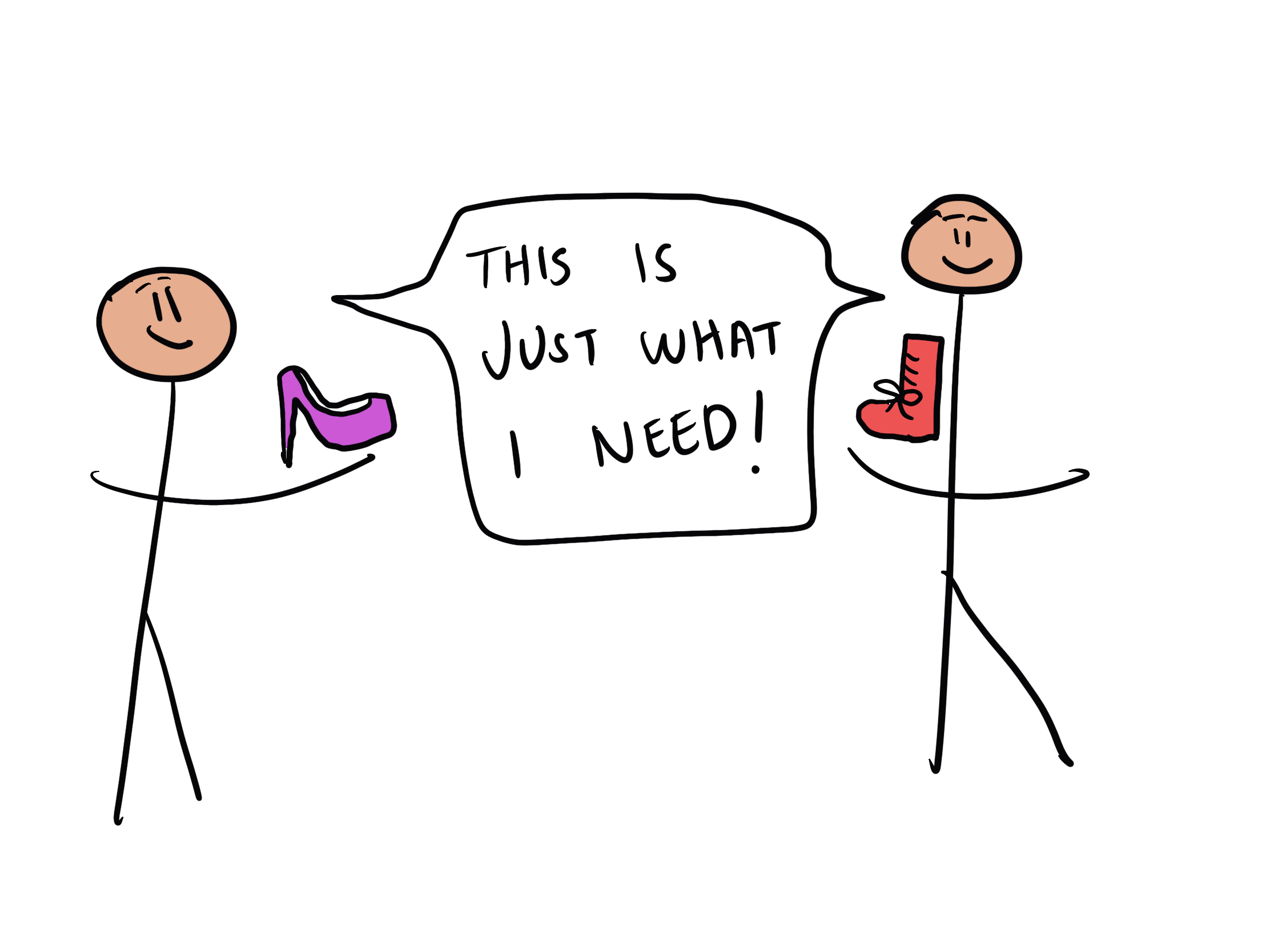
Companies target System 1's automatic, emotional judgments to imprint brand images and drive impulse purchase decisions. However, System 2's analytical thinking remains important -- providing logical evidence and information for high-value products increases effectiveness.
Financial Policy
Behavioral economics leverages the power of defaults -- for example, automatic savings increase policies in the US use System 1's tendencies to nudge people toward better behavior.
7. Common Misconceptions and Controversies
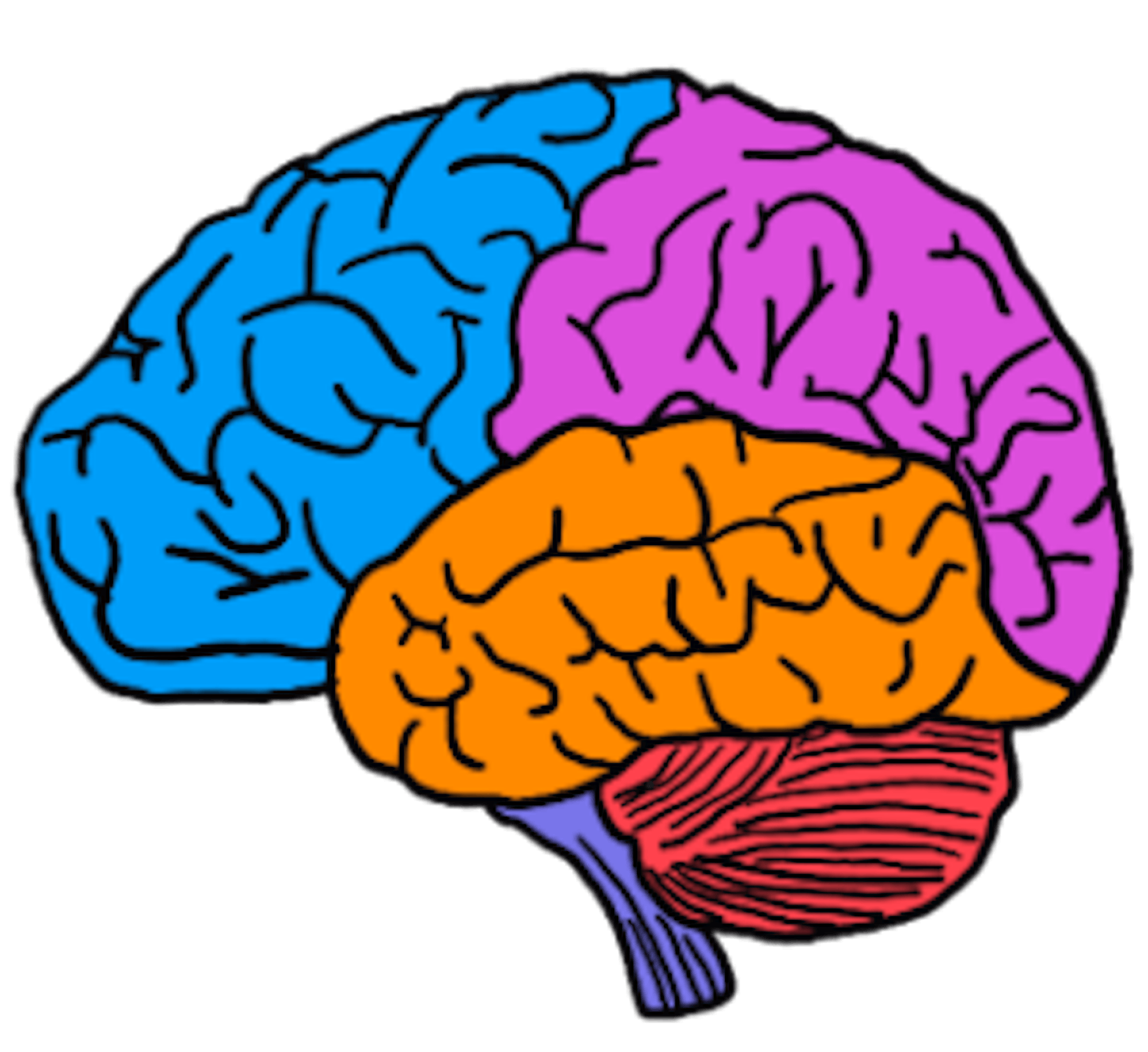
- Misconception 1: System 1 and 2 are specific brain regions?
- This is not true! Kahneman himself states that "no brain region can be called the 'home' of System 1 or 2."
-
Misconception 2: System 1 always acts first, then System 2 follows?
- In reality, the two systems operate in parallel, interacting and influencing each other.
-
Misconception 3: Only System 1 has biases, and System 2 is perfect?
- Both are susceptible to biases. For example, confirmation bias can cause System 2 to be used in defending incorrect beliefs.
8. Case Studies
The "Invisible Gorilla" Experiment
In 1999, in a video experiment where participants were asked to count basketball passes, nearly half of the participants completely failed to notice a gorilla costume crossing the screen. They were so absorbed in focused attention (System 2) that they missed information System 1 would normally catch automatically.

"You can also experience a surge of conscious attention whenever something surprising is detected. System 2 is activated when an event violates the model of the world that System 1 maintains. In that world, lamps don't jump, cats don't bark, and gorillas don't cross basketball courts."
-- Daniel Kahneman
This experiment shows that "focus" can sometimes cause us to miss available information, and it suggests that we may overlook important issues, much like ethical blind spots.
The M&M Advertising Campaign
In 1995, BBDO agency and Susan Credle revived the M&M brand through character personification. The Red, Yellow, Blue, and Green M&M characters became imprinted in our System 1, creating such a strong brand association that when the characters disappeared from advertisements over time, consumers spontaneously inquired about them.

9. Related Topics and Additional Resources
Conclusion
The System 1 and 2 thinking framework explains how quick "instinct" and deliberate "analysis" operate in our minds, illustrating how nuanced and complex human decision-making really is. Understanding these two systems can practically help us recognize biases, improve habits, and make better choices. The dual-process model is being applied across behavioral economics, marketing, finance, and many other fields, and its message of "balancing efficiency with deliberation" will remain relevant for years to come.