
This summary provides a detailed explanation of six core cognitive learning strategies that have received strong support from decades of research: spaced practice, interleaving, retrieval practice, elaboration, concrete examples, and dual coding. For each strategy, it presents the foundational research background, real-world application examples, and future research directions--helping educators understand effective learning methods and apply them in educational settings. It also offers insights into how these cognitive strategies are currently used in educational practice and what misconceptions exist.
1. Introduction: The Importance of Learning Science and the Gap in Current Education
Learning science has greatly contributed to our understanding of effective teaching and learning strategies, yet unfortunately many educators outside the field are unfamiliar with these research findings. Current education does not follow the evidence-based practice model of medicine. However, significant progress has been made over the past several decades in how cognitive processes are applied to education.
According to research by Dunlosky and colleagues in 2013, and Pashler and colleagues' report in 2007, a small number of learning techniques have been validated for their effectiveness both inside and outside the classroom. However, a 2016 textbook analysis (Pomerance et al., 2016) found that teacher training textbooks covering even some of these six core learning strategies are extremely rare, and none cover all of them. This suggests that these effective strategies have not been systematically introduced into educational practice.
Interestingly, in recent years--particularly in the UK--teachers with a deep interest in cognitive psychology have emerged. Many were inspired to explore learning science after reading the book "Make it Stick," and they have formed an evidence-based education conference network called "researchED," actively discussing cognitive psychology techniques and their educational applications through social media and blogs. These teachers' informal writings provide valuable opportunities to glimpse how learning science can be applied in classrooms, how it can sometimes be misused, and what questions the scientific literature has not yet addressed.
2. Spaced Practice
Spaced practice is considered one of the most powerful contributions of learning science to education. Even when studying the same amount of information repeatedly, distributing study sessions over time (rather than cramming all at once) is far more effective for long-term memory. Ebbinghaus first empirically demonstrated this effect in the 19th century through extensive study of his own memory. He found that the number of repetitions needed to relearn a series of 12 syllables could be cut nearly in half when learning was distributed over three days.
"With any considerable number of repetitions, a suitable distribution of them over a space of time is decidedly more advantageous than massing them at a single time." (Ebbinghaus, 1885/1913, Section 34)
Hundreds of subsequent studies have confirmed the effectiveness of spaced practice in both laboratory and classroom settings, with the effect being particularly pronounced over retention intervals of a month or more. Bjork and Bjork's (1992) "new theory of disuse" provides a mechanistic explanation for the benefits of spaced practice. According to this theory, memories have both retrieval strength (how easily a memory can be recalled at a given time) and storage strength (how deeply embedded the memory is in the mind, which cannot be directly measured). Both strengths increase when studying, but increases in storage strength are inversely proportional to retrieval strength. That is, the higher the current retrieval strength, the smaller the increase in storage strength. Therefore, information learned through cramming is quickly forgotten due to low storage strength despite high retrieval strength, while spacing learning allows retrieval strength to weaken before restudying, thereby increasing storage strength.
Teachers can introduce spaced practice in two ways:
- Creating opportunities to revisit information throughout the semester or even into the next semester. This may be challenging due to initial planning requirements and time constraints of covering a fixed curriculum, but it can be achieved with minimal burden by dedicating a few minutes of each class to reviewing information from previous lessons.
- Encouraging students to engage in spaced study on their own. This is suitable for high school students and above, and since advance planning is needed, it is important for teachers to help students plan their study schedules. For example, if classes are on Monday and Wednesday, they might suggest review sessions on Tuesday and Thursday. (See Figure 1)
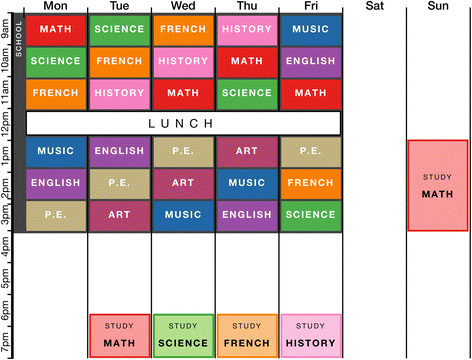 Figure 1: A spaced practice schedule for one week. Designed to represent a typical high school student's timetable. This schedule includes four one-hour study sessions, one longer study session on the weekend, and one day of rest. Each subject is studied the day after it is covered in school, creating a gap between the class and the study session.
Students may feel less confident with spaced practice than with cramming because spaced study is more difficult. But it is precisely this "desirable difficulty" that benefits long-term learning. While cramming may seem to "work" if the goal is passing an exam, the importance of long-term information retention should be emphasized.
In England, since 2013, high school students must remember content from three years prior on cumulative exams (GCSE and A-levels), so teachers who follow cognitive psychology have shifted priorities from the few weeks of "revision" just before exams to distributing learning over three years. For example, some teachers have suggested using homework as an opportunity for spaced practice on previous topics. However, questions remain about whether spaced practice can entirely eliminate the need for cramming periods, and how to determine the optimal spacing interval.
Research on optimal spacing intervals is complex, but has found that both the gap between study sessions and the gap between study and testing affect long-term retention. To help teachers apply these complex findings in the classroom, flexible spaced practice frameworks and simplified research paradigms are needed. For example, an Excel macro spreadsheet has been developed to help teachers plan delayed lessons. Yet teachers still question whether such sophisticated planning is better than simply manually selecting material they did not previously understand well and reviewing it later. Therefore, specific evidence-based tools and guidelines for implementing spaced practice most effectively and efficiently in the curriculum are needed, and researchers should evaluate the effectiveness of these tools in real classroom settings to provide educationally meaningful recommendations.
3. Interleaving
Interleaving is another scheduling technique that enhances learning efficiency. Unlike the common approach of solving the same type of problem multiple times in succession (blocked practice), interleaving involves alternating between different ideas or problem types. This principle is particularly useful in subjects like math and physics. For example, in a study with college students, Rohrer and Taylor (2007) found that students who solved math problems on calculating volumes of different shapes in random order performed better on a test one week later than students who solved the same type of problem consecutively. The same held true for seventh-grade students working on graph and slope problems. The benefits of interleaving are explained by the fact that students can develop the ability to choose which method to apply to various problem types, beyond simply learning a specific problem-solving method.
The benefits of interleaving can extend beyond problem-solving to other domains. It can be useful in situations requiring discrimination, such as matching paintings to artists for art history students. Kornell and Bjork (2008) reported that students who interleaved paintings by various artists showed higher success rates on later matching tests than students who studied one artist's paintings in blocks. Birnbaum and colleagues (2013) proposed the discriminative-contrast hypothesis, suggesting that interleaving enhances learning by enabling comparisons between examples from different categories, and found evidence supporting this hypothesis.
Another type of interleaving involves alternating between study and test opportunities. Students can alternate between solving problems and viewing examples. This pattern is particularly effective at reducing the time needed for procedural mastery. These alternating study and test opportunities may benefit through a process known as "test-potentiated learning"--that is, learning that occurs immediately after a retrieval attempt may be more effective than learning not preceded by retrieval.
When teachers use interleaving as an educational strategy, several caveats apply. Research has primarily focused on interleaving related material (e.g., solving different types of math equations). However, students sometimes ask whether they should interleave material from different subjects--an approach that lacks empirical support. Therefore, teachers should be cautious when guiding independent study. Since younger students can easily confuse the subtle difference between interleaving related and unrelated information, teachers of younger students should directly create interleaving opportunities in homework or quiz assignments. Learning apps such as Quizlet, Memrise, and Anki allow students to take teacher-created quizzes and provide built-in interleaving algorithms, relieving teachers and students of the burden of carefully planning when and how to interleave items.
Distinguishing between spaced practice and interleaving in educational settings can be challenging. Teachers often extend the term "interleaving" to mean a curriculum that revisits topics multiple times throughout the school year. This is closer to what cognitive psychologists call "spaced practice." (Figure 2b shows the visual difference between interleaving and spaced practice.)
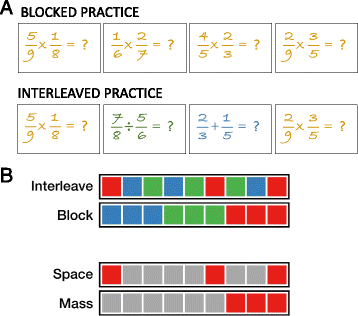 Figure 2: a Blocked practice and interleaved practice for fraction problems. In the blocked version, students solve four multiplication problems in a row; in the interleaved version, they solve a multiplication problem, a division problem, an addition problem, and then return to multiplication. b A diagram of interleaving and spaced practice. Each color represents a different homework topic. Interleaving involves alternating between topics instead of blocking them. Spaced practice involves distributing practice over time instead of massing it all at once. Interleaving inherently incorporates spaced practice by naturally "filling" the space between sessions with different interleaved tasks.
However, cognitive psychologists have not yet sufficiently studied the effects of structuring curricula in this way. Unresolved questions remain about whether repeatedly revisiting previous topics throughout the semester interferes with learning new information, what effective techniques exist for interleaving old and new information within a single class, and how to determine the balance between old and new information.
4. Retrieval Practice
Tests are primarily used in educational settings to assess performance, but a lesser-known benefit of testing is that testing improves memory for the tested information. If we think of our memory as a library of information, it may seem surprising that retrieval (what happens when we take a test) enhances memory. However, a century of research tells us that retrieving knowledge actually strengthens memory.
The memory-strengthening effects of testing have been known for over a hundred years, and in the past decade, research on the memory-enhancement benefits of retrieval practice has surged. The effectiveness of retrieval practice has been demonstrated across various age groups, from preschoolers to elementary, middle, and high school students, as well as college students. Additionally, retrieval practice has been applied to activities beyond simple tests, such as concept mapping, showing positive results.
There is ongoing debate about the effects of retrieval practice on more complex material. It has been shown to improve the ability to apply knowledge to new situations (e.g., transfer learning), but some studies have reported limited or no increase in transfer learning compared to restudying. The effects of retrieval practice on higher-order learning may actually be more sensitive to encoding factors (e.g., how learning materials are presented) than to the study itself. Furthermore, retrieval practice may be more beneficial for higher-order learning when it includes more scaffolding and targeted practice through application questions.
How does retrieval practice help memory? Figure 3 shows both the direct benefits and indirect benefits of retrieval practice.
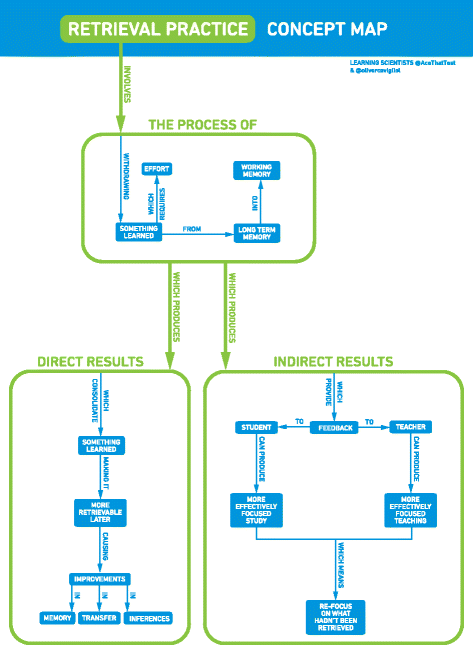 Figure 3: A concept map showing the process and resulting benefits of retrieval practice. Retrieval practice involves retrieving learned information from long-term memory to working memory, which requires effort. This creates direct benefits through consolidation of learned information, making it easier to remember later and improving memory, transfer, and reasoning. Retrieval practice also creates indirect benefits by providing feedback to students and teachers, which can lead to more effective learning and teaching practices by focusing on inaccurately retrieved information.
- Direct benefits: The act of retrieval itself is thought to strengthen memory. For example, even when information is merely mentally retrieved (covert retrieval) rather than explicitly produced, the information is remembered just as well as with explicit retrieval. We can conclude that the very act of bringing information to mind improves memory for that information, even without feedback or restudy opportunities.
- Indirect benefits: Engaging in retrieval practice can also yield indirect benefits. For example, when students anticipate being tested, this expectation enhances the encoding quality of new information. Additionally, frequent testing can help reduce mind-wandering--thoughts unrelated to the material students should be studying.
The benefits of retrieval practice depend to some extent on successful retrieval. Extremely low retrieval success rates are unlikely to help improve memory. However, if retrieval practice situations are structured to have too-high success rates, the act of bringing information to mind may be weakened, reducing benefits. Therefore, balancing retrieval success and overall difficulty is important. When initial retrieval success rates are low, feedback can help enhance the overall benefits of retrieval practice. Interestingly, some studies have reported that retrieval attempts themselves, rather than successful retrieval, provide learning benefits.
Retrieval practice is a powerful way to enhance meaningful information learning and can be implemented relatively easily in the classroom. For example, it can be as simple as asking students to put away their materials and write down everything they know about a particular topic. Teachers can employ various retrieval-based learning strategies, including short-answer or multiple-choice practice tests, open-ended prompts for information recall, and concept mapping from memory. What matters is that teachers provide opportunities for retrieval practice during the learning process. Prior research suggests that any activity that promotes successful retrieval of information will enhance learning.
In teacher blogs, retrieval practice receives considerable attention, with a focus on low-stakes or even no-stakes testing. This aims at improving learning rather than evaluating performance. In fact, a well-known charter school in England has a formal homework policy requiring 30 minutes of daily self-testing on subject knowledge instead of standard homework. Whether homework helps improve learning effectiveness is still debated, but whether including retrieval practice in homework would be more effective remains an open question.
Finally, there is the important consideration of test anxiety. While retrieval practice can be highly effective for improving memory, some studies show that pressure during retrieval can undermine some of the learning benefits. Students in high-pressure conditions performed worse on later tests than those in low-pressure groups. Therefore, test anxiety may reduce the learning benefits of retrieval practice. While eliminating all high-stakes testing is unlikely, teachers can provide students with many low-stakes retrieval opportunities that help improve learning. Low-stakes testing may help reduce test anxiety, and has recently been shown to counteract the harmful effects of acute stress on learning. This is a particularly important research direction for future studies, as many teachers unfamiliar with the effectiveness of retrieval practice may feel resistant to the pressure implied by the word "testing."
5. Elaboration
Elaboration refers to connecting new information to existing knowledge. Anderson (1983) stated: "One of the most powerful manipulations that can be performed in terms of enhancing a subject's memory for material is to have the subject elaborate on the to-be-remembered material." Postman (1976) concisely defined elaboration as "additions to nominal input," and Hirshman (2001) further elaborated this as "a conscious, intentional process of connecting information to be remembered with other information in memory." What these definitions share is that elaboration involves adding features to existing memories.
One form of elaboration is thinking about information at a deeper level. Craik and Lockhart's (1972) levels of processing framework predicts that information processed more deeply in terms of meaning (rather than form) will be better remembered. However, this framework has been criticized for the difficulty of measuring "depth"--that is, it can become circular reasoning: did we conclude that information was studied more deeply because it was better remembered, or that it was better remembered because it was studied more deeply?
Another mechanism through which elaboration benefits learning is through improved organization. Elaboration involves making information more integrated and organized with existing knowledge structures. By connecting and integrating information to be learned with other concepts in memory, students can increase the degree to which ideas are organized in their minds, and this increased organization facilitates the reconstruction of past information during retrieval.
Elaboration is a very broad term that can encompass various techniques, making it difficult to claim that it always helps learning. However, one specific technique within the elaboration category has relatively strong evidence for its effectiveness: elaborative interrogation, which involves students asking themselves questions about the material they are studying. Specifically, students using this technique ask "how" and "why" questions about the concepts they are studying. (See Figure 4 for an example related to the physics of flight.)
 Figure 4: Examples of "how" and "why" questions (i.e., elaborative interrogation) that students might ask while studying the physics of flight. To understand how physics explains flight, students might ask themselves: "How does an airplane take off?"; "Why does an airplane need engines?"; "How does lift work?"; "Why do wings have a curved upper surface and a flat lower surface?"; and "Why is there a downward airflow behind the wing?"
Most importantly, students should try to find answers to these questions by consulting materials or ultimately through memory. The process of seeking answers to questions with uncertainty can aid learning. However, when using this technique, it is important for students to verify their answers with materials or teachers, because content generated through elaborative interrogation can actually be harmful to learning if it is poor quality.
Students can also be encouraged to explain concepts to themselves while learning. This may include simply verbalizing the steps needed to solve an equation. Aleven and Koedinger (2002) found that self-explanation led to improved performance in two classroom studies investigating whether students provided self-explanations as directed by a "cognitive tutor" during problem-solving tasks. Ultimately, the greatest potential benefit of accurate self-explanation or elaboration is that students can transfer their knowledge to new situations.
The technical term "elaborative interrogation" has not yet entered the everyday vocabulary of education bloggers. Some teachers have blogged about elaboration in general (Hobbiss, 2016) and deep questions in particular (Class Teaching, 2013), but without using the specific terminology. This strategy may require more open dialogue between researchers and teachers to promote the use of elaborative interrogation in the classroom and address possible barriers to implementation. To advance scientific understanding of elaborative interrogation in classroom settings, it would be beneficial to conduct large-scale interventions to determine whether having students elaborate while reading actually helps comprehension. It would also be useful to know whether students should generate their own "how" and "why" questions or answer questions provided by others. Questions also remain about how long students should try to find answers, and when--given the level of expertise needed to perform this task well--is the right time to engage in this activity. Without answers to these questions, it may be premature to instruct teachers to use this technique in their classes. Finally, elaborative interrogation is time-consuming. Is this time being used efficiently? Or would students be better off answering a few questions, gathering information in class, and then moving to retrieval practice?
6. Concrete Examples
Providing supporting information is very important for learning key ideas and concepts. In particular, adding concrete examples to more conceptual content makes ideas easier to understand and remember. Concrete examples offer several benefits to the learning process:
- They can convey information concisely.
- They provide students with specific information that is easy to remember.
- They can leverage the superior memorability of pictures over words. (See "dual coding")
More concrete words are better recognized and recalled than abstract words. Additionally, concrete and imaginable information has been shown to enhance associative learning, even for abstract content. Therefore, providing concrete examples during instruction should improve memory not just for the concrete examples themselves but also for the related abstract concepts. Concrete examples can be useful not only during instruction but also in practice problems. Encouraging students to actively explain how two examples are similar and to extract the underlying structure on their own can also help with transfer. In one study, Berry (1983) showed that students performed well when given concrete practice problems regardless of whether they used verbalization (similar to elaborative interrogation), but verbalization helped students transfer their understanding from concrete to abstract problems. One particularly important area for future research is determining how students can best make connections between concrete examples and abstract ideas.
Since abstract concepts are harder to grasp than concrete information (Paivio et al., 1994), teachers should illustrate abstract ideas with concrete examples. However, care must be taken when choosing examples. LeFevre and Dixon (1986) found that when students were given both concrete examples and abstract instructions, if these did not match, students tended to follow the concrete examples rather than the abstract instructions, potentially limiting the application of abstract concepts being taught. Lew et al. (2016) investigated through interviews why students struggled to understand lectures and found that some issues were related to overall theme understanding rather than component understanding, and to the use of informal colloquialisms that did not clearly follow from the teaching material. Both of these problems could have been addressed by including more relevant concrete examples.
One concern with using concrete examples is that students may only remember the examples themselves, especially if they are entertaining or quirky, and fail to transfer their understanding to other examples or more broadly to abstract concepts. However, there appears to be no evidence that entertaining and relevant examples harm learning by impairing memory for important information. Rather, entertaining examples or jokes tend to be more memorable, but improved memory for jokes does not appear to come at the cost of memory for underlying concepts.
However, two important caveats should be emphasized. First, when more memorable content is unrelated to the concept of interest, learning of target information can be impaired. Therefore, all examples and quirky ideas should actually relate to the core concepts students need to acquire and should not include irrelevant perceptual features.
Second, novices tend to notice and remember the surface details of examples rather than the underlying structure. Experts, on the other hand, can extract the underlying structure from examples that are superficially different but structurally similar. (See Figure 5 showing physics examples.)
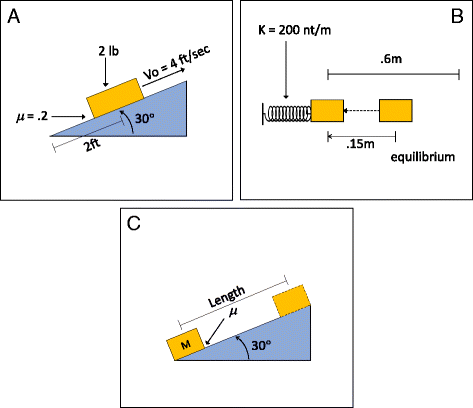 Figure 5: Three examples of physics problems that novices and experts would classify differently. Problems (a) and (c) appear superficially similar, so novices would group them into one category. However, experts would recognize that problems (b) and (c) both relate to the principle of conservation of energy and would group these two together.
Gick and Holyoak (1983) attempted to have students apply rules to problems that were superficially different but structurally similar. They found that providing multiple examples was more helpful for the transfer process than using a single example, especially when the examples had different surface details. Additional research is also needed on how to determine the number of examples sufficient for generalization to occur (though this will of course vary depending on contextual factors and individual differences). Further research on the continuum between concrete/specific examples and more abstract concepts would also be beneficial. That is, if examples are not sufficiently concrete, they may be too difficult to understand. On the other hand, if examples are too concrete, they may hinder generalization to more abstract concepts (though a diverse set of very concrete examples might help address this problem). In fact, in a controversial paper, Kaminski et al. (2008) argued that abstract examples were more effective than concrete examples. Later rebuttals to this paper challenged whether the distinction between abstract and concrete was clearly defined in the original study. The ideal point on this concrete-abstract continuum may also interact with development.
Finding teacher blog posts about concrete examples was more difficult than for the other strategies discussed in this article. One optimistic possibility is that teachers frequently use concrete examples in teaching and therefore do not think of it as a specific contribution of cognitive psychology. One blog post discussing concrete examples that we were able to find (Boulton, 2016) suggests this may be the case. According to Pomerance et al. (2016), the idea of "connecting abstract concepts with concrete examples" is covered in 25% of teacher training textbooks used in the United States. This makes it the second most frequently covered of the six strategies, after "asking deep questions" (i.e., elaborative interrogation). A useful direction for future research would be to determine how teachers actually use concrete examples in their teaching and whether suggestions for improvement can be made based on learning science research. For example, if two examples are better than one, are additional examples also needed, or is there a law of diminishing returns for providing more examples? And how can teachers best ensure that concrete examples align with prior knowledge?
7. Dual Coding
Both memory research and common sense support the idea that visual examples are helpful. The saying "a picture is worth a thousand words" embodies this idea. Indeed, it is well established that a simple picture can convey more information than several paragraphs of text. Pictures are particularly useful when concepts involve multiple parts or steps and the audience lacks prior knowledge. Figure 6 provides a concrete example showing how information flows through neurons and synapses.
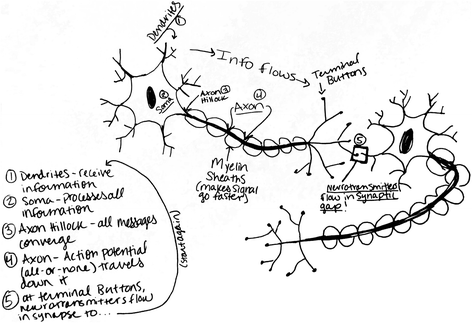 Figure 6: An example of using visual representations to enhance learning. Students can view a visual representation of neuronal communication alongside the provided words, or they can draw a similar visual representation themselves.
Beyond conveying information more concisely, pictures are remembered better than words. In memory research, this is called the picture superiority effect, and dual coding theory was developed to explain it. Dual coding theory starts from the concept of providing complementary visual information alongside text to enhance learning. Paivio (1971, 1986) proposed dual coding theory as a mechanistic explanation for processing information through the integration of multiple information "codes." In this theory, codes correspond to modal or other distinct representations of concepts. For example, "a mental image of 'book' has visual, tactile, and other perceptual properties similar to those evoked by the referent on which the image is based." Aylwin (1990) provides a clear example of how the word "dog" can evoke verbal, visual, and behavioral representations. (Figure 7 shows a similar example for the word "spoon.") Codes can also correspond to emotional properties. Broadly, dual coding theory proposes that providing multiple representations of the same information enhances learning and memory, and that information that more easily evokes additional representations (through automatic image processing) gains similar benefits.
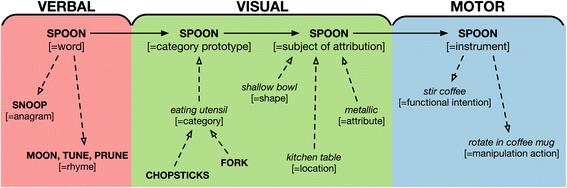 Figure 7: Examples of visual, verbal, and motor coding properties related to the word "SPOON." Words can evoke multiple types of representations ("codes" in "dual coding theory"). Seeing a word will automatically evoke verbal representations associated with its constituent letters and phonemes. Words representing objects (i.e., concrete nouns) will also evoke visual representations, including information about similar objects, the object's component parts, and where the object is typically found. In some cases, additional codes may also be evoked--for example, motor-related properties of the represented object, situational information related to the object's functional intent and manipulation actions, may also be automatically processed when reading the word.
Paivio and Csapo (1973) propose that verbal and imagistic codes have independent and additive effects on memory recall. Using visual materials to enhance learning and memory has been applied particularly to vocabulary learning, but has also been successful in other domains such as medicine. To leverage dual coding, verbal information should be accompanied by visual representations whenever possible. However, while all the studies discussed indicate that using multiple representations of information is beneficial, it is important to acknowledge that each representation increases cognitive load and can lead to overload.
Given that pictures are generally better remembered than words, it is important to ensure that the pictures provided to students are helpful and relevant to what they are learning. McNeill et al. (2009) found that providing visual examples reduced conceptual errors. However, McNeill et al. also found that students given visually rich examples did not perform better than students given no visual examples at all, suggesting that visual details can sometimes distract and hinder performance. Therefore, it is important to consider that images used in instruction are clear and unambiguous in meaning.
Extending the scope of dual coding theory further, Engelkamp and Zimmer (1984) proposed that motor actions such as "turning a handle" can provide additional motor codes that enhance memory, connecting enactment research with dual coding theory. The enactment effect appears to occur primarily at the time of learning rather than at retrieval. Similarly, Wammes, Meade, and Fernandes (2016) showed that drawing provides memory benefits that cannot be explained by visual imagery, picture superiority, and other memory-enhancing effects alone. Providing convergent evidence, words representing functional objects have been shown to enhance later memory even when explicit motor action itself is not important. This indicates that motor processes can enhance memory similarly to visual imagery, paralleling the memory differences between concrete and abstract words. Additional research suggests that automatic motor simulation of functional objects may be the cause of these memory benefits.
When teachers combine visuals and words in educational practice, they may not always leverage dual coding in the optimal way. For example, a recent discussion on Twitter involved a teacher who decided to have seventh-grade students replace specific words with pictures of those words in science lab reports. (E.g., the instruction "use the syringe to..." was replaced with a picture of a syringe.) Other teachers argued that this was not dual coding because there were no longer two different representations of the information. The first teacher argued that dual coding was maintained because the illustrated lab report would be used alongside the original fully verbal report. This specific implementation of replacing individual words with pictures has not been investigated in the cognitive literature, presumably because no benefit would be expected. In any case, we need to be clearer about the implementation of dual coding, and more research is needed to clarify how teachers can leverage the benefits of multiple representations and picture superiority.
Importantly, dual coding theory is different from the concept of "learning styles"--the idea that individuals benefit from instruction matched to their modality preferences. This idea is widespread and individuals often subjectively experience preferences. However, there is evidence that learning styles theory is not supported by empirical research findings. That is, there is no evidence that teaching students according to their preferred learning style leads to overall improved learning. Moreover, learning styles have been described as a myth or urban legend within psychology. Skepticism about learning styles is a common stance among evidence-based teachers. In a study providing evidence against the learning styles concept, Kraemer, Rosenberg, and Thompson-Schill (2009) found that individuals classified as "verbal learners" and "visual learners" did not perform better on experimental tests matched to their preferences. Instead, learning through one's preferred style has recently been found to be associated with higher subjective judgments of learning, but not with objective performance. In contrast to learning styles, dual coding is based not on tailoring instruction to individual preferences, but on providing additional and complementary forms of information to enhance learning.
Conclusion
The six learning strategies examined here can produce even more powerful effects when combined in real educational settings. For example, spaced practice is particularly effective for learning when combined with retrieval practice. Interleaving new and previous material naturally produces a spacing effect. Concrete examples can take not only verbal but also visual forms, leveraging the benefits of dual coding. Additionally, elaboration, concrete examples, and dual coding strategies are all most effective when used as part of retrieval practice.
For example, in the concept mapping studies mentioned earlier, creating concept maps from memory was more effective for later recall than creating concept maps while viewing the material. When practicing elaborative interrogation, students should initially use class materials to answer "how" and "why" questions, then gradually progress to finding answers from memory. And when interleaving various problem types, students should practice actually answering problems rather than simply reviewing solution procedures.
However, despite these ideas about strategy combinations having empirical foundations, it is not yet clear whether the learning benefits of these strategies are additive, superadditive, or in some cases incompatible. Therefore, future research should proceed in the following directions:
- Better formalize the definitions of each strategy (especially elaboration and dual coding).
- Identify best practices for classroom implementation.
- Clarify the boundary conditions of each strategy.
- Strategically investigate the interactions among the six strategies discussed in this article.
It is hoped that such research will be actively pursued so that learning science can be applied more effectively in educational settings.