Short summary: 25 social, technological, and economic trends appearing in the U.S. and around the world in 2025, presented in order. From marriage and religion to news consumption, AI, children's health, and global issues — the piece unpacks major patterns and their significance using data, charts, and striking quotes. A quick way to grasp the complexity of social change at a glance.
1. Marriage Has Become a "Luxury Good"
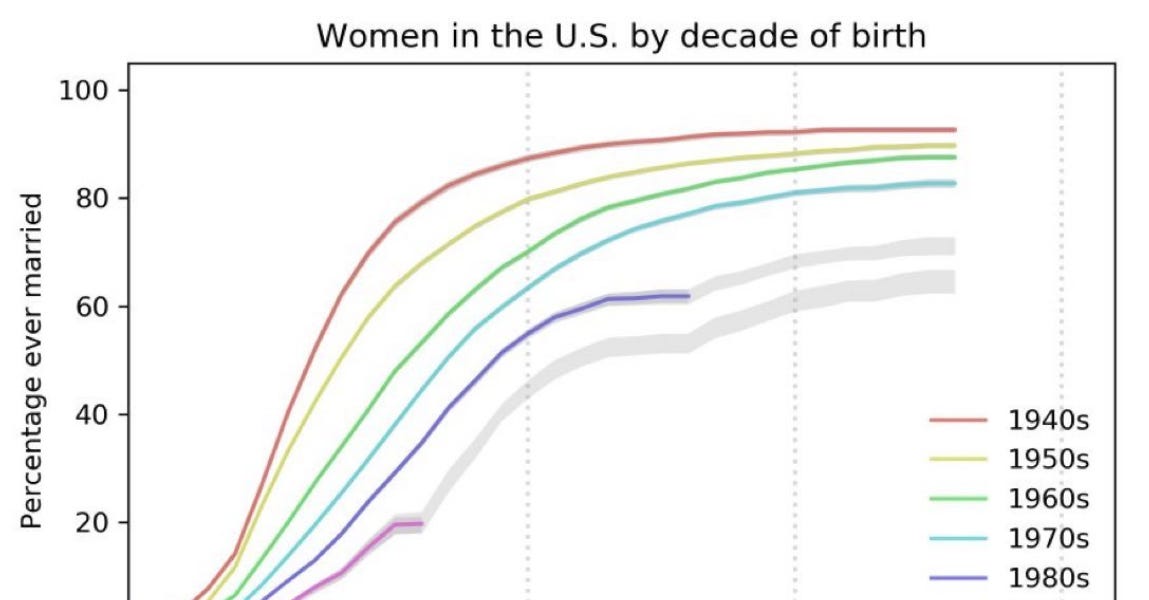
Marriage in America is becoming increasingly rare and delayed. Among women born in 1940, 80% were married by age 25; among those born in 1990, only around 20% were. This shift has transformed marriage and divorce patterns across society, with marriage rates falling most sharply among lower-income and less-educated groups. Today, marriage is concentrated among the highly educated and high-income — and their divorce rates are lower too.
"The divorce rate for first marriages that began in the 2010s is on track to reach its lowest point since World War II."
Marriage is increasingly becoming a marker of a prosperous life.

2. The Youth Religious Revival Is Mostly Hype
There has been a lot of recent news about Gen Z returning to religion, but the data tells a different story. According to survey findings released by data analyst Ryan Burge, Gen Z has the lowest rate of attending religious services at least once a week, and the share who say they "never attend" has hit an all-time high of 38%.
"When Boomers were in their twenties, only 15% never attended religious services. Among Gen Z today, that number is 38%."

3. Half of Americans No Longer Get News from News Sources
Half of Americans now get their news not from traditional outlets (newspapers, online media) but from social media and influencers. This is a reality that both journalists and political commentators can't afford to ignore. The influence of "the news" is shrinking, and algorithms and personalized information are increasingly shaping public perception.

4. The Age of Asociality Is the Age of Meaninglessness
Young people today socialize and go to parties less than before, spending more time alone — and most of that alone-time goes to solitary entertainment like watching TV, gaming, and scrolling social media. That isn't necessarily bad in itself, but young people themselves report these activities as the "least meaningful" things they do.
"The meaning that twenty-somethings report getting from solitary entertainment is far lower than what they get from caring for children or spending time with friends."

5. Young People Are Drinking Less
Among younger generations, the belief that even moderate drinking is harmful to health has surged. Alcohol consumption has fallen to historic lows — and at the same time, this generation tends to be more anxious, more asocial, and more introverted.
"Alcohol makes me less anxious, friendlier, and more extroverted. Which may be why young people today seem more anxious, less friendly, and less extroverted than before."

6. Sexual Activity Has Declined Too
Among men aged 22–34, the share reporting no sexual activity in the past year has nearly doubled since the mid-2010s. This shift hints at a significant personal and social inflection point.

7. 1872: The Year That Transformed Political Freedom
The introduction of the secret ballot in 1872 was a turning point for political liberty. Before that, voting was a public, collective performance. With the secret ballot and the private voting booth came the freedom to choose based solely on one's own convictions, free from outside pressure.
"Now a vote can be interpreted purely through the lens of an individual's beliefs and values, without external coercion."
8. Trump Has Completely Reshuffled the White Voter Landscape
The voting patterns of white Americans have been historically turned upside down. In the past, wealthy whites voted Republican and poor whites voted Democratic — but now it's the reverse: the poorest white voters lean Republican, while wealthier whites lean Democratic.
"Since the Trump era, the inversion of white voter behavior is the most dramatic shift in modern electoral history."

9. Southern States Are Dominating Housing Supply
States in the American South — South Carolina, Florida, Texas, Tennessee, Georgia, and others — are constructing new housing (new builds per 1,000 residents) at rates far exceeding the rest of the country. Meanwhile, California, New York, and Massachusetts lag far behind in new construction.

10. Why Do English-Speaking Countries Struggle with Housing Supply?
Over the past decade, the U.S., U.K., Canada, Australia, and New Zealand have had among the weakest new housing construction in the OECD. The root cause isn't entirely clear, but one theory is that long historical and legal traditions have fostered deep resistance to new development projects.

11. Walkable Cities Extend Your Life
A 2025 study tracking two million people found that people who moved to denser, more walkable neighborhoods walked an extra 1,100 steps per day (1,400 in New York). The upshot: moving to a walkable city is estimated to add roughly three months to your life expectancy over ten years.
"Moving to a more walkable city adds about an hour of moderate-to-vigorous physical activity per week."
12. AI Accounts for All Job Growth in Tech
According to Mary Meeker's AI report, all employment growth across the IT sector in recent years has come from AI jobs — the rest of tech hiring has stagnated or declined. In other words, without AI, there would have been no net job growth in the technology sector.

13. America's Infrastructure Investment Is Concentrated in AI
Meta, Google, Microsoft, Amazon, and other major tech companies have invested $100–200 billion in AI infrastructure (chips, data centers, etc.) over just the past six months. This is being described as the largest infrastructure buildout in history — on par with the computer era of the 1960s and the railroad era of the 1880s.
"AI's share of capital investment has surpassed the dot-com bubble and is approaching the heights of the railroad gilded age."
14. The Stock Market Is Now an AI Story
The top 10 stocks in the S&P 500 (mostly AI-driven Big Tech) have accounted for an overwhelming share of net earnings growth over the past six years. At this point, it makes more sense to think of it as the "S&P 10 vs. the S&P 490."
15. Everyone Is Using AI
Today, two-thirds of Americans interact with AI several times a week. Among those under 30, that figure rises to 75%. The pace of AI adoption is faster than the telephone (which took decades to spread) and closer to the rate at which television became universal.

16. Self-Driving Cars Are Quietly Succeeding
The prediction in 2015 that "self-driving cars will be mainstream by 2020" didn't pan out — but as of 2025, autonomous taxis in California are logging more than 4 million miles per month. Notably, autonomous vehicles are far safer than human drivers, and some estimates suggest a full transition could save millions of lives worldwide.
17. The Strongest Case That AI Won't Destroy White-Collar Work: Jevons' Paradox
There is widespread fear that AI will take human jobs — but history suggests otherwise. The spreadsheet, Excel, and gains in efficiency didn't eliminate jobs; they caused explosive growth in the very roles they touched. In other words, AI is likely to generate more ideas and "production," ultimately expanding the era of the knowledge worker.
"Because of AI, more people — not fewer — may become knowledge workers or influencers."
18. Historically, Automation Shifts the Value of Labor Rather Than Eliminating It
A 1956 U.S. congressional report predicted that automation would reduce low-skill labor while increasing the number of complex, skilled jobs and management positions — and that prediction turned out to be remarkably accurate.
"Automation eliminates some production jobs, but the net effect is to create new jobs requiring higher skills."
19. As AI Gets Smarter, Are We Getting Dumber?
The author confesses: "I'm fundamentally optimistic, but the recent decline in reading comprehension, problem-solving, and critical thinking among adolescents and adults is genuinely worrying." With AI making it easy to cheat on homework and assignments, and screens and social media eroding attention spans, some analysts suggest we may have already passed "peak human brain power" and are now on a downward slope.

20. "Reindustrialization" Policy Has Produced the Opposite Result
The Trump administration expected tariffs and protectionist trade policy to revive American manufacturing — but in reality, both U.S. manufacturing output and employment are in a recessionary decline. The assessment: Trump-style industrial policy has weakened the non-AI manufacturing base.
21. The Grift Economy
The FTC (Federal Trade Commission) reports that investment fraud has surged sharply in recent years — a shadow cast by the digital economy.
22. The Top 10% Account for Half of All Consumption
Roughly 50% of total U.S. consumer spending comes from the wealthiest 10%. Worth noting: the shift toward this concentration accelerated notably in the mid-1990s, when the middle class was still relatively comfortable.
23. Falling Vaccine Trust Is Endangering Children's Health
Since COVID-19, vaccine hesitancy has surged, and childhood vaccination rates for essential vaccines like measles and polio have dropped sharply since 2021. As a result, measles in the U.S. is now at its worst outbreak in the 21st century, and the risk of vaccine-preventable diseases spreading nationally is growing.
"When trust in vaccines falls, children get sicker — it's that simple."

24. Global Child Health: Obesity Has Replaced Hunger as the Problem
In 1953, more than 25% of children in India died before age 5; today that figure is around 3% — a dramatic improvement. The leading causes of child death have shifted from infection and malnutrition to obesity. As of 2025, for the first time in human history, there are more obese children worldwide than underweight children.
"Progress is, in many ways, replacing old problems with new (and slightly better) ones."
25. The World Is Terrible. The World Is Much Better. The World Can Be Even Better Still.
The core of the author's philosophy can be summed up as:
"The world is simultaneously terrible, much better than it used to be, and capable of becoming better still."

Closing
This piece illustrates just how complex and dynamic the world around us has become, through the lens of countless social, technological, economic, and health changes unfolding in 2025. The world is still full of problems — but it also captures how remarkable progress and new challenges are appearing side by side. 🧭✨