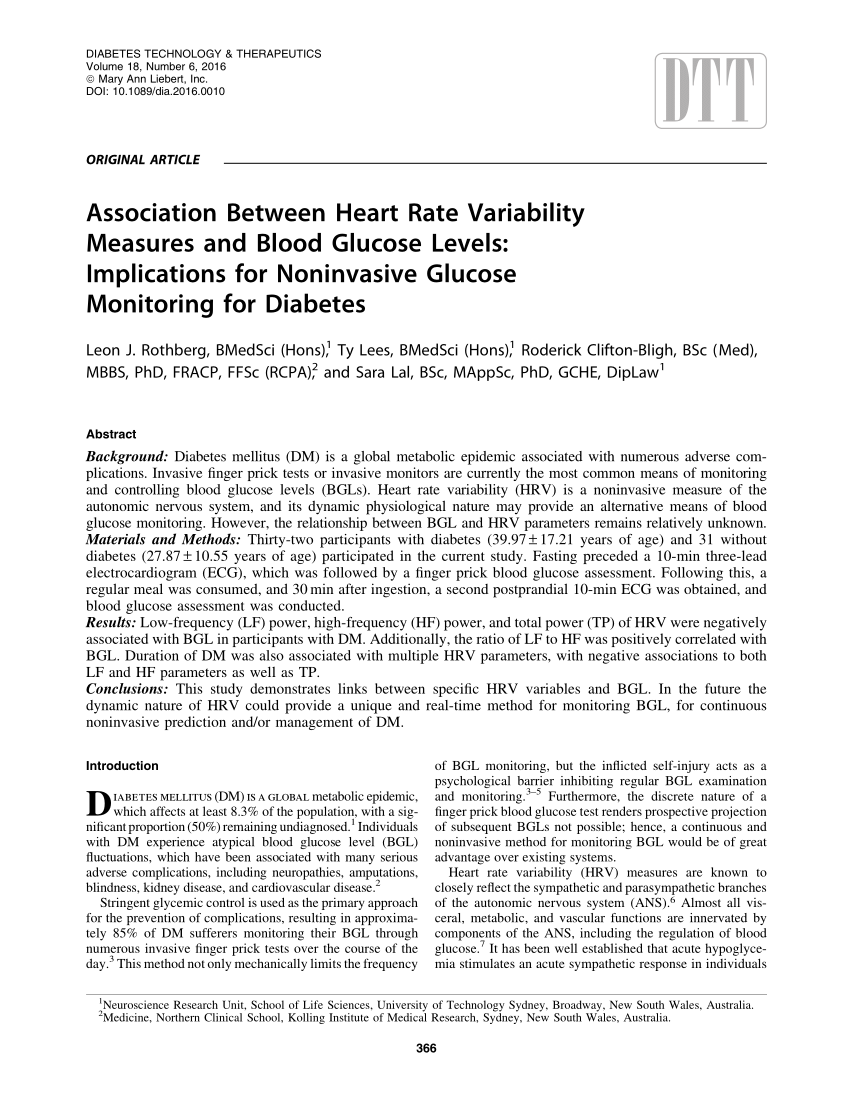
Brief Summary This paper studies the relationship between heart rate variability (HRV) and blood glucose levels (BGL), presenting the possibility that HRV could be used to non-invasively track blood glucose in real time for diabetes patients. In an experiment with 63 participants, a clear correlation between HRV and blood glucose was observed, particularly in diabetes patients. HRV-based non-invasive blood glucose monitoring could become a revolutionary alternative to conventional finger-prick methods.
1. Research Background and Objectives
Diabetes is an extremely common metabolic disease worldwide, increasing the risk of various complications (neuropathy, blindness, kidney disease, etc.). To date, blood glucose monitoring has relied primarily on invasive methods such as finger-prick testing or implantable sensors. However, these methods face significant practical difficulties including pain, psychological barriers, and limitations on measurement frequency.
"Finger-prick testing and implantable glucose monitors still present psychological and mechanical barriers. Non-invasive, continuous glucose measurement methods could offer significant advantages over existing approaches."
The primary objective of this study was to determine how heart rate variability--a non-invasive indicator reflecting autonomic nervous system activity--relates to blood glucose, and whether it can be used as a blood glucose monitoring tool.
2. Research Methods: Participant Selection and Experimental Procedures
The study included 32 diabetes patients (mean age 40, 21 T1DM and 11 T2DM) and 31 non-diabetic controls (mean age 28). The experiment proceeded as follows:
- Participants fasted for at least 8 hours before the experiment
- First ECG (10 minutes) recorded, immediately followed by fasting blood glucose measured via finger-prick
- Regular meal consumed (calories recorded)
- Second ECG (10 minutes) recorded 30 minutes post-meal, along with post-meal blood glucose via finger-prick
- Blood pressure measurements and other health information collected before and after
ECG signals were processed and frequency-analyzed to obtain low frequency (LF), high frequency (HF), total power (TP), and LF/HF ratio. All HRV parameters were natural log-transformed before statistical analysis to reduce bias.
3. Key Results: The Relationship Between HRV and Blood Glucose
Experimental results showed significant differences between diabetic and non-diabetic groups.
3.1 Between-Group Differences
- The non-diabetic group had significantly higher LF, HF, and TP values compared to the diabetic group, and a lower LF/HF ratio.
- Between T1DM and T2DM, there were no major differences in HRV values, blood glucose, or diabetes duration, though T2DM patients were older with higher BMI and systolic blood pressure.
"In our study, diabetes patients showed overall lower HRV (low frequency, high frequency, total power) values compared to non-diabetic controls."
3.2 Correlation Between HRV and Blood Glucose
- In the non-diabetic group, no significant correlation between HRV and blood glucose was found.
- Only in the T2DM group were significant results observed:
- HF (high frequency) and blood glucose showed a negative correlation (higher blood glucose associated with decreased HF)
- LF/HF ratio and blood glucose showed a positive correlation (higher blood glucose associated with increased ratio)
- The T1DM group alone did not show a clear correlation, but when all DM groups were combined, consistent trends were observed between HF, LF/HF, TP and blood glucose.
"HF (high frequency) activity decreased as blood glucose concentration increased, and the LF/HF ratio increased as blood glucose rose."
- In multiple regression analysis, LF/HF and TP explained 31% of fasting blood glucose variance, with LF/HF as the strongest predictor.
4. The Relationship Between HRV and Diabetes Duration
Longer diabetes duration was associated with progressive decreases in HRV indicators (particularly LF, HF, TP). This was more pronounced in T1DM than T2DM, and is a noteworthy finding given that the average duration was approximately 12 years (the point at which complication risks increase).
"As diabetes duration increased, LF, HF, TP, and other HRV values generally decreased. This suggests potential use as a sensitive indicator of subtle autonomic neuropathy."
5. Discussion and Implications
5.1 Physiological Mechanisms Between HRV and Blood Glucose
- Hyperglycemia affects HRV through various pathways including increased sympathetic nervous system substances (norepinephrine), parasympathetic suppression (decreased HF), neural damage (particularly the vagus nerve), and induction of oxidative stress and inflammatory responses.
- Existing research has repeatedly reported the "inverse correlation between HF and blood glucose" and "positive correlation between LF/HF and blood glucose."
5.2 Clinical and Technical Application Potential
- Several studies have successfully developed hypoglycemia and hyperglycemia prediction algorithms based on HRV signals, raising expectations for non-invasive, real-time blood glucose monitoring methods that could transform diabetes management paradigms.
"By integrating HRV signals with AI algorithms, it should be possible to detect hypoglycemic and hyperglycemic states in real time. Ultimately, this could connect to automated insulin delivery systems like an 'artificial pancreas.'"
- Integration with wearable devices such as smartwatches is also approaching reality, offering the potential to revolutionize the inconveniences of existing invasive monitoring.
6. Limitations and Future Directions
- This study was a short-term observation (cross-sectional study), with constraints on dynamic change analysis due to the lack of 24-hour continuous measurement data.
- Longer-duration, larger-sample studies with sophisticated signal analysis and machine learning approaches are needed to improve the reliability of the HRV-blood glucose relationship and prediction models.
Conclusion
This study demonstrates that heart rate variability (particularly the LF/HF ratio and HF values) has significant associations with blood glucose and diabetes duration, supporting the potential for HRV-based non-invasive blood glucose monitoring. HRV signal analysis is expected to become an innovative tool for clinical blood glucose management and diabetes complication prevention.
"The dynamic characteristics of HRV could be used in the future as a unique, real-time, non-invasive method for predicting and managing blood glucose."
Reference Keywords
- Heart rate variability (HRV)
- Blood glucose level (BGL)
- Autonomic nervous system (ANS)
- LF, HF, LF/HF, TP
- Non-invasive blood glucose monitoring
- Diabetes management
- Wearables, AI, continuous glucose monitoring (CGM)
Closing Thoughts
This study supports the feasibility of non-invasive blood glucose prediction through HRV, suggesting that a future where more people can manage their health without the inconvenience of blood glucose monitoring may be possible. There is much to look forward to as broader data, long-term tracking studies, and advanced technology convergence continue into the future.