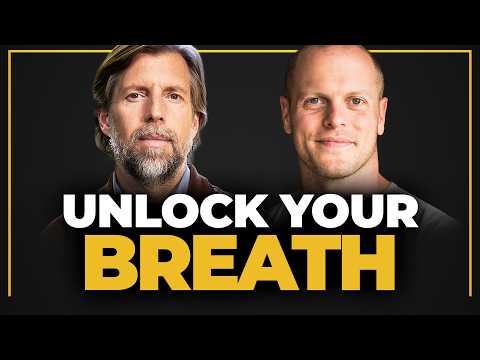
What if just changing the way you breathe could dramatically transform your health, sleep, focus, and even athletic performance? Science journalist and bestselling author of Breath: The New Science of a Lost Art, James Nestor, shares a comprehensive overview of the power of breathing, the importance of nasal breathing, the link between poor sleep breathing and ADHD, and practical breathing techniques and sleep environment improvements anyone can start using right away. The video delivers generous, practical, and scientifically-grounded breathing tips alongside the author's life and writing experiences.
1. Why Does Everyday Breathing Matter?
The video opens with a fascinating study conducted in Italy. When people followed the steady rhythm of traditional prayers — slowly exhaling for 5-6 seconds and inhaling for 5-6 seconds — their various physiological systems entered a "coherence state," which maximizes bodily efficiency and calm.
"When all systems work together, we call it 'coherent breathing.' It's the state where our body operates most efficiently."
The emphasis is that even this basic breathing practice can significantly improve anyone's baseline health. Breathing is one of the few autonomic bodily functions we can also consciously control, presenting an intriguing perspective that it's like "an API for easily managing our nervous system."
2. Miraculous Breathing Techniques — Tummo and Wim Hof
James Nestor introduces some of the most influential breathing tradition practitioners, especially Maurice Daubard, a French breathing master in his ~90s, and his practice of "Tummo breathing."
Maurice nearly had part of his lung removed due to severe childhood respiratory disease, but miraculously recovered his health through yogic breathing taught by a missionary and achieved superhuman levels of fitness. He set records that defy common sense — cycling at 5,000m altitude in the Himalayas, 55 minutes in ice water, and running 240km in the desert.
"People said he was crazy. But really, his life was a continuous miracle created by breathing."
Tummo breathing is an ancient technique from Tibetan Bon Buddhism — a method of slowly inhaling and exhaling to raise body temperature and store energy. "Traditional methods and commercialized modern approaches, like Wim Hof's intense hyperventilation and breath holds, coexist," he explains.
"True Tummo is secretive; Tibetan masters follow you for nearly 10 years before gradually giving hints. It's that deep a world."
James practices the commercially known Wim Hof-style Tummo himself, emphasizing that "it's possible to rapidly raise body temperature through breathing alone when it's cold." However, he warns that extreme cold exposure can be dangerous.
3. How Breathing Changed the Author & the Link Between ADHD, Sleep Disorders, and Breathing
James Nestor was already managing his health well through diet, exercise, and sleep, yet kept suffering from chronic respiratory conditions (pneumonia, bronchitis, etc.). "A doctor's recommendation to try breathing techniques completely changed my life," he says, describing his first breathwork experience:
"It wasn't particularly hard — I was just breathing rhythmically in a dark, cool room — but my whole body was drenched in sweat. It felt like something enormous trapped inside me had been released."
The latest research on ADHD and sleep-disordered breathing is also covered in depth. He strongly argues that "childhood ADHD patients almost perfectly overlap with those who have sleep-disordered breathing like snoring and sleep apnea," and that breathing and sleep patterns should be assessed before simply prescribing medication.
"Most children with ADHD aren't breathing properly. Jumping straight to medication without a proper evaluation is really problematic."
4. At-Home Sleep Breathing Self-Assessment and Improvement
- To check for sleep-disordered breathing in yourself, children, or others, observe whether they breathe through the mouth, snore at night, or make harsh breathing sounds.
- Install an app (e.g., Snorl, Snore Clock) on your phone to record sounds overnight and check graphs — useful for catching early warning signs.
- The core improvement strategy is to force the habit of breathing through the nose. Practice nasal breathing consciously during the day, and once accustomed, apply a small tape ("Myotape," etc.) on the lips for sleeping.
"At first, sleeping with tape on was really tough. Stick with it for 2 weeks and it completely changes. I've been using it for 7 years — now I actually can't sleep well without it."
Many reports exist of children significantly improving bedwetting and ADHD symptoms through mouth tape or Myotape tools.
5. Indoor Air Quality (Especially CO2) and Its Deep Connection to Health
- High indoor carbon dioxide (CO2) concentrations cause severe headaches, reduced focus, cognitive decline, and chronic fatigue.
- Outdoor CO2 levels are around 425ppm, but indoors, especially on airplanes or in high-end eco-certified hotels, levels can soar to 1,500-3,000ppm!
- At 1,500ppm, students' test scores drop by 50%, and above 2,500ppm, chronic headaches and significant cognitive decline occur.
"Ever wonder why everyone falls asleep on planes? It's not because they're tired — it's because the CO2 in the air is insanely high."
"The more eco-certified a hotel is these days, the more they just recirculate air and seal all the windows. The air quality is terrible."
Practical Tips for Improving Indoor Air Quality
- Carry a CO2 monitor (like Aranet4) and check air quality. Always confirm in advance that the hotel has windows that can open at least slightly.
- Use red-toned night lights instead of LEDs (to protect circadian rhythms), along with electronic stimulation devices, various supplements, and mouth tape as essential travel kit items.
6. Self-Care Know-How: Electronic Medical Devices, PEMF, and Supplements
- PEMF (Pulsed Electromagnetic Field therapy) was once dismissed as "superstition," but recent scientific research has been growing in areas including pain treatment, biorhythm regulation, immunity, and viral suppression.
- Eastern Europe and Russia have been actively using it for 60-70 years, and it's expected to become a highly prominent field going forward.
"The era of chemical drugs has reached its limits. Electronic and frequency-based treatments will be the breakthrough in next-generation healthcare."
For supplements, the basics include vitamin D, K2, E, nattokinase, and CoQ10. He practically emphasizes that he carries his "travel supplements" in a grandmother's pill case!
7. Athletic Performance, the BOLT Score, and Optimal Breathing
- Even top athletes often don't properly practice deep, diaphragmatic breathing.
- The BOLT Score (Body Oxygen Level Test) lets you check your breathing efficiency, and those with low scores can increase it 2-3x through practice.
- Breathe naturally through the nose 3 times → after the last exhale, pinch your nose and hold.
- Record the time when you first feel the urge to breathe. As the score increases, CO2 tolerance and overall efficiency improve.
"What really matters isn't fancy techniques but the 'fundamentals.' Big breaths, deep breaths, slow breaths — the diaphragm must move."
- Like muscles, breathing muscles can also be trained with resistance training (inspiratory trainers and various resistance devices) and massage/physiotherapy.
- For mouth tape, don't jump straight to using it overnight — gradually get used to it during the day for 10-20 minutes first.
8. Writing, Career, and Creative Tips
The second half of the video unfolds James Nestor's life as a journalist and author.
- He says "writer's block" is just an excuse for professional writers — "writers whose livelihood depends on it sit down and finish no matter what."
- He candidly confesses the painful process of cutting a 290,000-word manuscript down to 85,000 for his first book. He emphasizes the need for engaging "story" structure and narrative rather than just "information."
- He conveys the lesson that content must "become 'entertainment' that's enjoyable to read," not just data or information.
- The turning point that awakened him as an author was covering the world freediving championships, where pursuing curiosity and authenticity on-site led all the way to a book.
"That's when I truly felt I could survive in this path. Even unsolvable manuscripts — solutions always come eventually."
9. Heart Rate Variability (HRV), Breathing, and "The Most Important Fundamentals"
- The 5-6 seconds inhale, 5-6 seconds exhale "coherent breathing" pattern found in Buddhist, Hindu, Catholic, and other thousand-year-old prayer and mantra traditions creates an "optimal state" across HRV, blood pressure, brain oxygenation, and mind-body calm.
"Even without complex prayers, just inhaling for 5-6 seconds and exhaling for 5-6 seconds makes your brain and body run most efficiently."
- More important than "breathwork" group culture is restoring and maintaining a "normal," natural breathing pattern — for anyone, anywhere.
10. Specific Posture and Environmental Tips for Better Sleep Quality
- Sleep quality depends not just on mouth tape but on both posture and environment.
- Develop the habits of nasal breathing and sleeping on your side carefully and gradually.
- When sleeping on your back, the back of the lungs can't fully expand, making breathing harder — attaching a ball or sock to the back of your t-shirt is also recommended.
- (Just as the "prone position" helped COVID patients) sleeping on the side or stomach is advantageous for oxygen intake.
- Elevating the head of the bed by about 6 inches ("incline bed therapy") can also help.
- Make full use of apps like Snorl, Snore Clock, and various wearable devices (sleep and oxygen saturation monitoring).
Conclusion
James Nestor repeatedly emphasizes that the starting point of all change is the originally natural and "healthy fundamental breathing," rather than complex techniques, expensive equipment, or elaborate meditation. If you practice the simple methods verified through numerous studies, real cases, personal experience, and real-world testing one at a time, anyone can "reboot their life's performance through breathing alone," he says emphatically.
"Start by inhaling deeply for 5-6 seconds and exhaling slowly. The beginning is simple, but the effects are remarkably powerful."
Keyword Summary
- Nasal breathing
- Habituation with mouth tape (Myotape, etc.)
- BOLT score check and training
- Indoor CO2 management
- Heart rate variability and breathing rhythm alignment (5-6 second cycle)
- Diaphragmatic breathing during exercise and daily life
- Start slowly and gradually
- (Sleep) Side sleeping, head elevation, and environmental adjustments
- Breathing is the most powerful "tool" to easily transform your health
Want to learn more? James Nestor's official Instagram: @mrjamesnestor Official website: mrjamesnestor.com Book: Breath: The New Science of a Lost Art
Try experimenting and experiencing these techniques — start with small changes in the "art of breathing" that every modern person should know