Bloom's Taxonomy is a tool that helps structure learning objectives step by step. It can be broadly applied to setting goals appropriate to the learner's level, assessment, and instructional design. This guide covers Bloom's six levels, key considerations when applying them, practical goal examples, and actual objective design steps in a clear and approachable way.
1. What Is Bloom's Taxonomy?
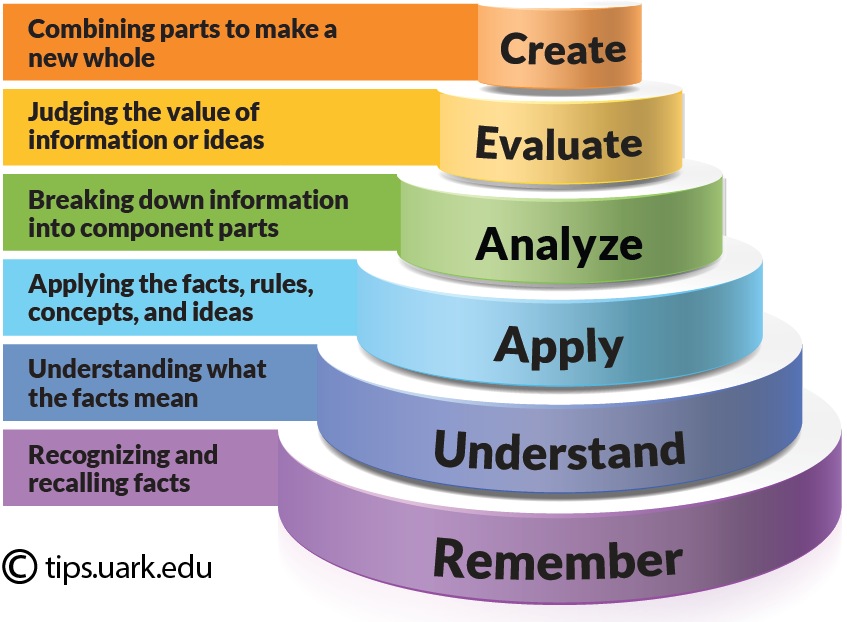
Bloom's Taxonomy is a framework that systematically classifies learning objectives and educational skills. It was proposed in 1956 by psychologist Benjamin Bloom at the University of Chicago, and the terminology has recently been revised into six levels:
- Remembering: Retrieving, recognizing, and recalling information from memory.
- Understanding: Constructing meaning through interpreting, exemplifying, classifying, summarizing, inferring, comparing, and explaining.
- Applying: Carrying out or using a specific procedure or method in practice.
- Analyzing: Breaking material into its parts and determining how the parts relate to one another or to an overall structure.
- Evaluating: Making judgments and critiques based on criteria, and reviewing validity and quality.
- Creating: Generating new structures, patterns, or solutions to problems.
Bloom's Taxonomy is often represented as a pyramid or cake-shaped hierarchy. Higher levels require more advanced thinking and skills.
"Each level builds upon the knowledge and skills of the levels below it."
2. Using Bloom's Taxonomy in Learning Objective Design
Bloom's Taxonomy is a powerful tool across learning objectives, lesson design, and assessment design. For example:
- You must remember before you can understand,
- Understanding is needed before you can apply,
- Analysis must come before evaluation,
- Thorough evaluation must underpin creative conclusions.
"Before you can understand a concept, you must first be able to remember it."
In practice, it's inefficient to walk through every level for all content, so goals are set according to the learner's level.
- For beginners or first-year students, focus on fundamentals (remembering, understanding) with some stretch into applying/analyzing.
- For advanced students or graduate students with a solid foundation, reduce simple memorization goals and raise the bar to analyzing, evaluating, and creating.
3. Using Bloom's Taxonomy and Verbs in Learning Objectives
Effective objectives should be built around measurable and clear verbs, and there's a "Verb Table" to help with this.
"For example, the verb 'explain' could belong to the understanding level, but depending on context, it could also be an analysis-level verb."
Key Verbs and Objective Examples by Bloom's Level
| Level | Representative Verbs (Examples) | Learning Objective Example |
|---|---|---|
| Creating | Design, develop, create, etc. | "By the end of the lesson, the student can design a problem using the principle of conservation of energy." |
| Evaluating | Evaluate, judge, grade, etc. | "The student can select between conservation of momentum and energy conservation and evaluate the validity of each." |
| Analyzing | Distinguish, analyze, explain, etc. | "The student can analyze and explain the difference between potential and kinetic energy." |
| Applying | Calculate, apply, solve, etc. | "The student can calculate the kinetic energy of a projectile." |
| Understanding | Explain, interpret, summarize, etc. | "The student can explain Newton's three laws in their own words." |
| Remembering | Define, identify, recite, etc. | "The student can accurately recite Newton's three laws." |
"Whenever possible, each objective should contain only one measurable verb."
4. Alignment with Quality Matters Standards
To satisfy Quality Matters (educational quality evaluation standards):
- Objectives must be measurable
- Avoid vague, unmeasurable verbs like "understand," "learn," or "enjoy"
- The level of achievement (e.g., applying, creating) requires corresponding assessments (projects, written responses, presentations, etc.)
"If the objective is at the applying level, a simple multiple-choice test alone cannot verify whether it's been achieved."
5. The Difference Between Course Goals and Lesson Objectives
Course goals are broad and difficult to assess directly. Typically, 3 to 5 are sufficient. Lesson objectives break down course goals into smaller parts, so that multiple lesson objectives together confirm the achievement of one course goal.
"When all lesson objectives have been achieved, you can consider the corresponding course goal met."
In Bloom's Taxonomy:
- Course goal verb level >= the verb levels of its supporting lesson objectives
- Example: If the course goal uses "illustrate" (applying), then lesson objectives should use verbs at the remembering/understanding/applying levels, not higher levels (analyzing, evaluating, creating).
6. Steps for Writing Effective Learning Objectives
- Each objective must include exactly one measurable verb.
- An objective should not contain two or more verbs. (e.g., "define and apply" -- what if they can only define (remember) but not apply? Assessment becomes impossible.)
- Check that the verb hierarchy aligns between course and lesson levels.
- All objective statements should maintain clarity, measurability, and conciseness.
"Noting the Bloom's level in parentheses next to each objective verb makes review easier and clearer."
Example:
Course Goal 1. (Applying) Demonstrate why transportation is a critical link in the supply chain.
1.1 (Understanding) Discuss how the global business environment is changing.
1.2 (Applying) Demonstrate the unique characteristics of transportation and its impact on global supply chains.
7. Reference Materials Before Designing Actual Objectives
View actual objective examples and "before/after" comparisons: Learning Objectives Before and After Examples
View the complete Bloom's Verb Table: Bloom's Taxonomy Verb Chart
Conclusion
Bloom's Taxonomy is a powerful tool for making course and lesson objective design clear and systematic. Remember that choosing the right Bloom's level for the learner, selecting appropriate verbs, and writing specific, measurable objectives are the keys to successful instructional design.
"Clear, level-appropriate learning objectives are the starting point of effective learning."