When a new technology or methodology is born, the problem it is trying to solve must exist first. You can expand your understanding of OKR by knowing what existing problems it was designed to solve. Today I'm going to talk about that.
Companies that use OKR well
Where are the companies that are using OKR well? A representative example would be Google. Twitter, Uber, Netflix, Spotify, Amazon, Lyft, etc. are known. So why did these companies abandon existing objective management tools such as KPI and settle on OKR? To know that, we first need to understand the nature of the tech industry we work in.
OKR vs KPI
I don't think OKR is suitable for all companies. For some companies, existing tools such as KPI may be more suitable and useful than OKR. For example, in industries such as insurance sales and smartphone sales, monthly sales or sales volume are set as KPIs, and if they are achieved, they are rewarded with incentives, and if they are not achieved, they are penalized for excellent goal management.
The characteristic of KPI is that achieving the KPI becomes a life-or-death task. The headquarters always presents challenging goals compared to the previous month or year, and each organization risks its life to achieve those numbers. KPIs are useful for chasing linear growth like this.
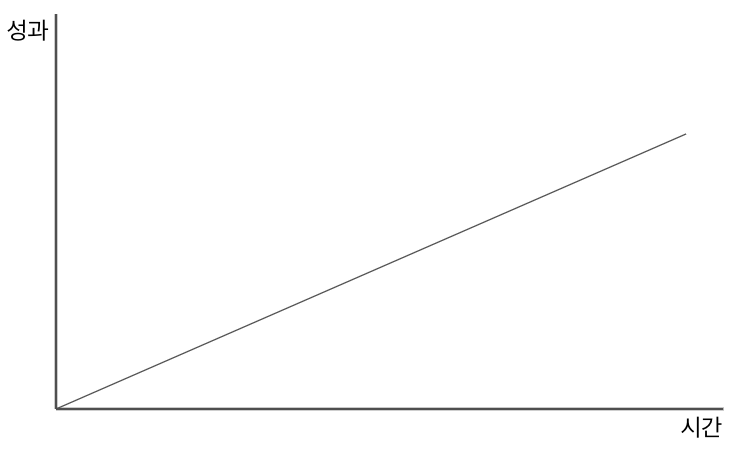
linear listing graph
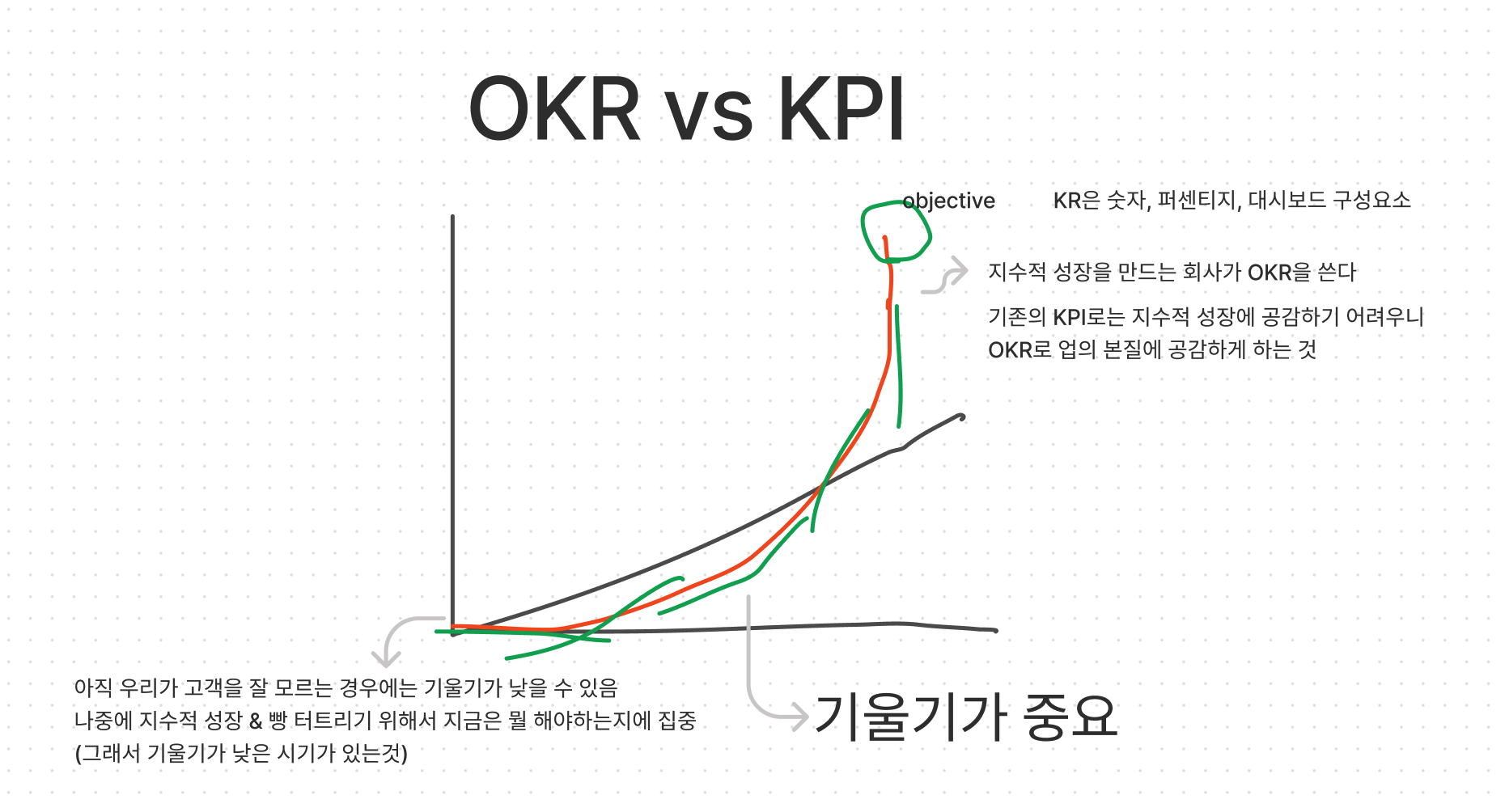
However, the nature and growth graph of startups and tech companies are very different. One of the biggest characteristics of the tech industry is that exponential growth, not linear growth, is possible and pursued. It was impossible to capture this characteristic with existing tools such as KPI.
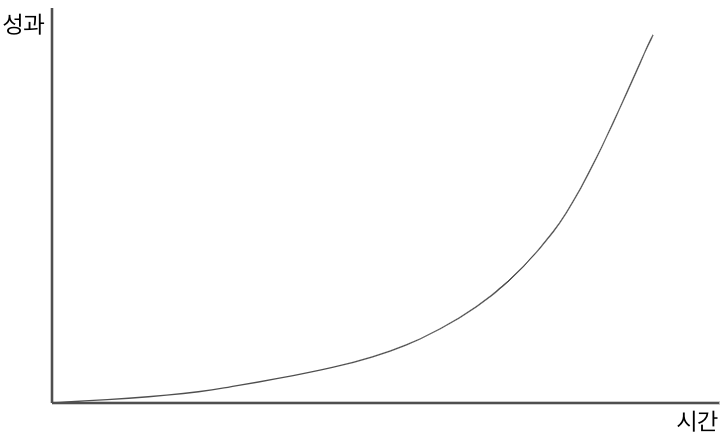
exponential growth graph
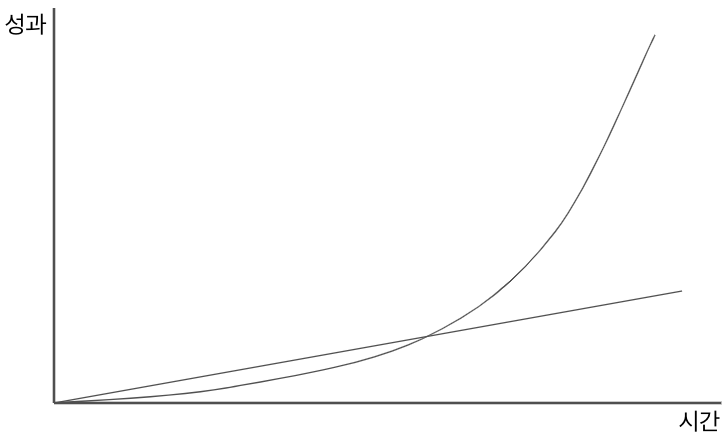
Linear growth vs exponential growth
Don't forget, exponential growth!
OKR can express and chase this exponential growth. Its usefulness has been proven in several tech companies, including Google. The big dragon in our hearts is not confined to simple numbers, but always draws the big picture and changes the frame to make it come true. Don't forget that the moment we chase linear growth instead of exponential growth, we are a startup prone to failure. 😉
What is Objective in OKR?
In OKR, O stands for Objective. Objective means goal. But if you just ask me to set a goal, it doesn't really make sense, right? At times like this, just think of this exponential growth graph. OKR's Objective is not just tomorrow's goal or this year's goal. It refers to the end picture of exponential growth that each organization and individual vividly draws when we try to run at full speed to achieve the grand mission of our company.
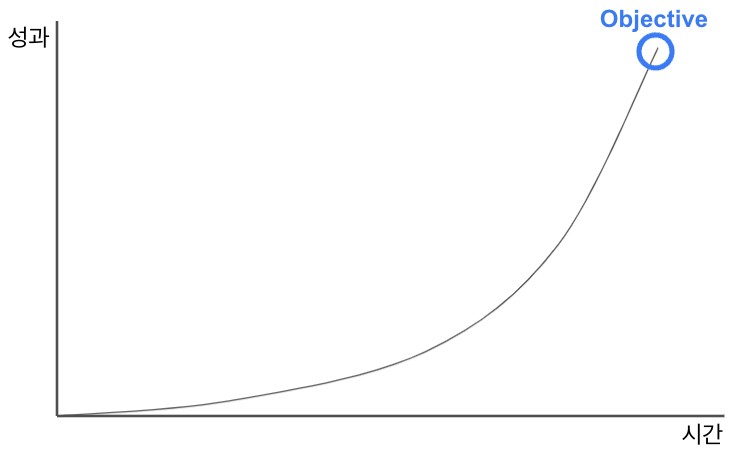
What is Objective in OKR?
What are Key Results in OKR?
The key result in OKR is how to measure Objective, the big goal described above. If what indicators and numbers change, can we say that we have achieved the objective we set? Yes. John Doer, the father of OKR, is said to use this motto. "I will (Objective) as measured by (this set of Key Results)."
know thyself, lean
When pursuing an objective and trying to achieve exponential growth, and how to approach it strategically to achieve that goal, there is a concept that you should always keep in mind. It's slope. Exponential growth doesn't just happen. It's not easy. It is difficult to achieve quickly. If you achieved it quickly and easily, congratulations, you didn't aim big enough. In order to not lose focus when taking a difficult path, we must ask ourselves what slope we are currently on in the exponential growth graph.
Exponential growth can be broadly divided into investment period and harvest period. The investment stage is the stage of experimenting, establishing direction, and resolving bottlenecks to ensure that the necessary tasks are being carried out smoothly in order to achieve exponential growth. Based on that, the harvest stage is the stage where you focus entirely on performance, enjoy the sweet fruits, and secure and maintain a monopoly position in the industry or segment.
How to is not OKR
OKR ends with an Objective and Key Results that measure it. How to achieve the goal is not discussed at all during the OKR setting stage. Let's just say it's not important. If the goal we want is clear and we have agreed on how to measure it, we have complete autonomy over how to achieve it. For example, an initially thought-out approach may turn out to be completely wrong in the first experiment. If OKR needs to be modified at this time, it wasn't OKR.
OKR's sufficiently meaningful and large goals are usually not shaken by a single experiment. After the experiment, you will try again with a better How to. In this way, how to understand that if you focus on OKR, it can change flexibly or go in a completely different direction compared to the plan, and see how to do the best according to the situation through quick experimentation with customers and the market, quick learning, and quick execution.
In practice! OKR improvement case
(delete)